

E-wallet support varies by casino, and a fast deposit does not guarantee the same withdrawal timing or bonus eligibility.
How e-wallets fit into UK casino payments
An e-wallet can sit between a casino account and a player’s payment arrangements, but its presence does not make it a universal route. UK casinos commonly accept debit cards, while e-wallet support depends on the site. PayPal, Skrill and Neteller are named options in the market, but availability at one casino does not establish availability at another. An e-wallet therefore belongs in the payment mix as a conditional option, not as a standard feature of every UK casino.
The practical value depends on what the wallet is being used for. A payment method can be attractive for handling a transaction yet less useful when a promotion is involved. Specialist casino reviews describe PayPal as popular for speed and convenience, while also noting that some casino bonus terms exclude PayPal deposits. That is a reported feature of particular offers, not a rule that can be applied across the market. The relevant calculation is whether the value of a promotion survives the payment method’s eligibility terms; a headline offer has little monetary value if the chosen deposit route disqualifies it.
When choosing a UK casino that accepts e-wallets, payment details matter, including how long withdrawals may take. Use the available payout information below as one point to consider.
1. EvoSpin
Payout speed: 1-3 business days EvoSpin lists a payout speed of 1–3 business days.
2. SpinFormula
Payout speed: 1-3 business days SpinFormula lists a payout speed of 1–3 business days.
3. Zombillion
Payout speed: 1-3 business days Zombillion lists a payout speed of 1–3 business days.
4. BeOnBet
Payout speed: 1-3 business days BeOnBet lists a payout speed of 1–3 business days.
5. Jetsetspins
Payout speed: 1-3 business days Jetsetspins lists a payout speed of 1–3 business days.
6. Revery Play
Payout speed: 1-3 business days Revery Play lists a payout speed of 1–3 business days.
7. NightWin
Payout speed: 1-3 business days NightWin lists a payout speed of 1–3 business days.
8. Chanze
Payout speed: 1-3 business days Chanze lists a payout speed of 1–3 business days.
9. SlotoSport
Payout speed: 1-3 business days SlotoSport lists a payout speed of 1–3 business days.
10. Amunbet
Payout speed: 1-3 business days Amunbet lists a payout speed of 1–3 business days.
A similar qualification applies to Skrill and Neteller. Specialist reviews report that these wallets are available at some sites and may be excluded from promotions. The exclusion is a condition to price into the decision, rather than a reason to treat the wallet itself as unsuitable. Where the offer matters, its payment-method rules are part of the offer’s actual terms. Where no promotion is being considered, that restriction may have no practical effect.
Skrill has a wider role in current reporting than a niche alternative. Specialist reviews of UK-facing casino sites describe it as one of the more commonly listed deposit choices in 2026. That observation does not establish that every site accepts Skrill, or that acceptance includes every account. It indicates that Skrill is a method worth recognising when considering the payment landscape, while the specific route remains site-dependent.
This distinction matters because the phrase “accepts e-wallets” can conceal several different questions. It may refer to a wallet displayed among deposit methods, an account that can use that wallet, or a payment that remains compatible with a particular promotion. Those are not interchangeable conditions. A method’s general popularity says nothing conclusive about an individual casino’s current terms; equally, a restriction in one offer does not show that the wallet has no broader use.
An e-wallet also does not, by itself, define the whole payment relationship. It is one component of the casino’s available payment arrangements, alongside commonly accepted debit cards and other routes. Its fit is strongest when the wallet is already part of the account holder’s normal finances and the casino’s terms permit the intended use. If it introduces a promotion restriction or is not available for the account, the convenience described in a review may not translate into a useful option in practice.
Casinos That Accept Giropay in the UK · Casinos That Accept Citadel in the UK: What to Check
That is why broad claims about the “best” wallet are incomplete without a stated priority. Speed, convenience and promotion eligibility can point in different directions. A wallet praised for ease of use may be less attractive when a bonus depends on paying through an eligible method. Conversely, a promotion restriction may be irrelevant to someone making a deposit without claiming an offer. The result depends on the conditions attached to the actual transaction, not on a general ranking of payment brands.
E-wallets are therefore best understood as a flexible but conditional part of UK casino payments. PayPal, Skrill and Neteller can be relevant names to look for, but availability and promotion treatment are not uniform. Specialist reviews provide useful context about reported popularity and restrictions; they do not replace the terms that govern a specific account and offer. The central trade-off is straightforward: convenience has practical value only when the selected wallet is accepted for the intended use and does not undermine the terms attached to the transaction.
Checking whether a casino’s payment terms match
A payment logo on a casino’s information page is only a starting point. It does not establish that the route is available to every account, that the specific payment product is eligible, or that it can be used for the intended transaction. The practical check is whether the cashier, account details and payment provider’s terms align.
Checking Payment Compatibility
- Verify the method is visible in the cashier for your account
- Confirm casino terms allow the method for the intended transaction
- Ensure the payment account name matches the casino account name
- Check if the specific card product is eligible under current terms
- Verify the wallet funding route complies with credit-card fund restrictions
A specialist review may list Visa and Mastercard among a site’s payment methods, but that listing is not confirmation of current UK availability or eligibility for a particular card product. The cashier is the relevant place to verify what the account can use. A method mentioned in general terms may not appear for a particular customer, while a card brand’s presence alone does not show that every card issued under it will be accepted.
The same distinction applies when comparing casinos that accept e-wallets. A site may display a wallet name without making the route usable for every account or every purpose. The payment screen should show whether the method is available to the account and whether it is offered for the intended transaction. If the terms are unclear, the method should not be treated as confirmed merely because it appears in promotional copy or a general payments list.
Account ownership is another part of compatibility. The casino account details and the payment route should belong to the same customer. When names or basic ownership details do not match, a transaction can encounter avoidable friction. Using one named account consistently for both depositing and withdrawing is often the cleanest arrangement: it makes the ownership link easier to establish and reduces ambiguity over where funds came from.
Casinos That Accept iDEAL in the UK: What to Check · Casinos that accept eCheques in the UK: payment checks
This is especially relevant to e-wallets, where the wallet account is separate from the casino account. The matching question is not simply whether both accounts exist, but whether the wallet is in the same customer’s name and can be used within the casino’s stated terms. A route that works for someone else, or at another operator, is not proof of compatibility for the account under review.
The wallet’s funding rules also matter. UK-licensed casinos cannot accept wallet payments where the wallet allows credit-card funds to be used for gambling. A wallet appearing in the cashier is therefore not, by itself, sufficient confirmation that every way of funding that wallet is permitted. The relevant route must meet the casino’s terms and the UK rules applying to gambling payments.
A useful comparison keeps the checks separate:
- Is the method visible in the cashier for the account?
- Do the casino’s terms allow that method for the intended transaction?
- Does the payment account belong to the same customer as the casino account?
- For a card, is the specific product eligible under the current cashier terms?
- For a wallet, does its funding route comply with the restriction on credit-card funds?
These checks establish whether the method fits, not whether it is the best choice in every other respect. A payment route can be compatible while having different timing or charges from another route; those are separate terms and should not be inferred from availability. Likewise, a method’s appearance does not promise that it will remain available unchanged. The cashier is the operational check at the point of use.
The phrase “best e-wallet casino” can suggest that one operator is universally suitable, but payment compatibility is account-specific. A more useful comparison is whether the preferred wallet is actually offered, whether its account ownership matches, and whether the route can be used as intended under the stated terms. A broad list of casinos or payment logos cannot settle those points.
For cards, the same discipline applies: Visa or Mastercard branding does not determine current UK availability or establish that a particular card product qualifies. For e-wallets, the provider name does not establish that a wallet account or its funding source meets the casino’s requirements. In both cases, the cashier and the relevant terms—not the label alone—decide whether the route matches.
Do
- Use the cashier to verify current UK availability
- Ensure account ownership details match the payment route
- Use one named account consistently for deposits and withdrawals
Don’t
- Assume a payment logo confirms eligibility for every account
- Rely on promotional copy to confirm a method’s usability
- Use a payment route belonging to another person
A consistent route with matching account ownership leaves fewer basic details to resolve. When the cashier’s options and the account’s circumstances do not line up, the apparent convenience of the payment method is only packaging; the usable option is the one the account can actually select under the applicable terms.
Deposits and withdrawals follow different timelines
An e-wallet deposit and a withdrawal are separate transactions, even when both involve the same account. The first records money arriving at the casino; the second requires the casino to approve a payment out and send it through an eligible route. A successful deposit therefore confirms that the incoming payment worked, not that a later payout will be released on the same schedule.
That distinction matters when comparing casinos that accept e-wallet deposits. A cashier may show a wallet as an available way to fund an account, while the withdrawal process has its own checks and rules. The wallet’s role at deposit does not, by itself, establish how quickly a withdrawal will be reviewed, which destination will be used or when the funds will arrive.
A withdrawal has an approval stage before delivery. A specialist review identifies the casino’s internal processing and the account’s verification status as factors in withdrawal speed. This is separate from the time taken by a payment provider after the casino releases the funds. A payout can still be pending with the operator even though the original deposit appeared promptly; the visible account balance is not a timetable for money leaving the casino.
Casinos That Accept Revolut in the UK · Interac at UK Online Casinos: What to Check
Verification can add work, particularly when a first withdrawal is being processed. The same specialist review notes that initial payouts may take longer while checks are completed. That does not mean every first withdrawal will be delayed, but it does mean a deposit-only view of the process misses a separate approval step. If account checks remain outstanding, choosing a fast deposit route cannot remove them.
KYC status is therefore part of the payout calculation, not an administrative detail unrelated to payment. Withdrawal speed depends in part on whether the account is fully verified, as well as on the casino’s internal approval process. The method selected for the deposit cannot settle either question. A wallet transaction may be accepted immediately while the account still needs review before a payout can proceed.
The destination can also be constrained by closed-loop rules. UK anti-money laundering requirements usually mean that a payout must go back to the original payment source. This is why the route used to deposit can matter later, but not because it sets the withdrawal speed. It may determine where funds are returned, while approval and account verification determine when the casino is ready to release them. Returning funds to the source is an anti-fraud control, not a promise of instant delivery.
Keeping the account details and payment route under the same customer’s name can reduce avoidable questions about ownership. If the deposit route belongs to someone else, or the account information does not align with the payment details, the operator may need to resolve that discrepancy before proceeding. This is a practical point about transaction handling: consistent ownership makes the basic record easier to reconcile, but it does not replace KYC or guarantee a particular processing time.
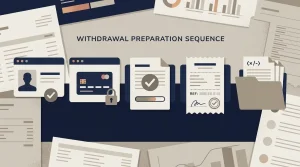
Payout Process Sequence
Step 1: Deposit Acceptance
Funds are sent via the chosen method and recorded in the casino account.
Step 2: Withdrawal Request
A payout is requested, triggering the casino’s internal approval process.
Step 3: Account Verification
The operator performs KYC checks and verifies the account status.
Step 4: Fund Release
The casino approves the payout and sends funds back through the permitted route.
For e-wallet deposit casinos in the UK, the useful comparison is therefore not simply whether a wallet button appears in the cashier. The relevant sequence is whether the deposit is accepted, whether the account is ready for withdrawal checks, whether the casino has approved the payout and whether the funds have been sent back through the permitted route. These are distinct events. Treating them as one continuous transaction can make a normal review stage look like a failure of the wallet itself.
A payment status should be read according to where the transaction is in that sequence. A completed deposit says little about the operator’s later decision to approve a withdrawal. A pending payout may still be awaiting internal review; an approved payout has passed that stage but may not yet have reached the destination account. The status labels and explanations on the casino account are more informative than the speed of the earlier deposit.
For anyone assessing a casino’s payment terms, the practical measure is the full route from deposit to release, rather than the first movement of money alone. Deposit acceptance, account verification, casino approval and return to the original source each have a separate role. An e-wallet can make the incoming transaction straightforward; it cannot make those later stages disappear.
Which payment options appear in the UK market
UK casino payment pages can show several distinct routes rather than a single standard cashier. A specialist review of UK-facing sites describes Visa and Mastercard, bank transfers, e-wallets and several cryptocurrencies among the methods listed. That spread is a snapshot of what appears across the market, not a promise that every route is offered by every casino.
Ukash Casino Payments in the UK: What to Check
E-wallets form one part of that mix. PayPal, Skrill and Neteller are familiar names, while Payz and Jeton illustrate how availability can vary between providers and sites. Payz is the name now used for EcoPayz, following its rebrand in 2022. Jeton has a narrower presence: a specialist review reports that it remains available at a handful of UK online casinos in 2026. Its appearance in the market is therefore more limited than the broad category label “e-wallet” might suggest.
Apple Pay also appears, but its role should be described precisely. Some UK Gambling Commission-licensed casinos accept it for deposits. That does not make it a universal casino payment route, or establish that it is available for every transaction type. Its presence is one example of a wallet-based option appearing alongside conventional cards and bank payments.
The wider menu includes debit cards and bank transfers, as well as digital currencies on some casino sites. These are not all variations of the same service. A card payment uses a card network; a bank transfer moves funds through banking channels; an e-wallet involves a separately held wallet account; and cryptocurrency uses a different payment infrastructure. The cashier’s labels reflect those different routes, even when they sit together on one page.
Names can also make the market look more uniform than it is. “E-wallet” describes a category, not a shared provider or a guarantee of common terms. PayPal, Skrill, Neteller, Payz and Jeton are separate services, and a casino listing one does not imply that it lists the others. Likewise, the presence of one wallet on a casino site does not establish that all wallets are accepted there. The market is a patchwork of individual payment menus, not a fixed national catalogue.
E-wallets
Includes providers like PayPal, Skrill, Neteller, Payz, and Jeton; availability varies by site.
Cards and Bank Transfers
Commonly accepted routes including Visa, Mastercard, and open banking options.
Cryptocurrencies
A distinct payment infrastructure including Bitcoin, mentioned on some casino sites.
Apple Pay
A wallet-based option accepted for deposits at some UKGC-licensed casinos.
Cryptocurrency may appear in the same broad payment landscape, but it should not be mistaken for an e-wallet. A specialist review of casino websites records several cryptocurrencies among the methods mentioned, without making them equivalent to card, bank or wallet payments. Bitcoin is one named cryptocurrency; its appearance in a payment menu belongs to a different route from depositing through an e-wallet.
This variety matters when describing UK casinos that accept e-wallets. The phrase covers sites offering at least one wallet route, not a standard package of every provider. Some names have a wider profile in casino payment descriptions, while others are reported only at a limited number of sites. Apple Pay adds another distinct option at some licensed casinos, specifically for deposits. None of these market-level descriptions means the same combination will appear across all operators.
The practical picture is therefore a mixed payment environment: cards and bank transfers sit alongside e-wallets, with cryptocurrency also mentioned on some sites. Within the wallet category, provider names and market presence differ; Payz reflects a rebrand, and Jeton has a reported handful of UK casino outlets in 2026. Apple Pay is present at some UKGC-licensed casinos for deposits. That is the range visible in the market, rather than a single uniform set of options.
Deposit-only vouchers and minimum amounts
A prepaid voucher has a different role from an e-wallet account. Paysafecard is used to put funds into a casino account; it is deposit-only, so it is not a route for receiving casino funds. That distinction matters when comparing payment methods: a voucher may cover the entry transaction without serving as an all-purpose account for money moving in both directions.
Casinos That Accept Tether in the UK: Payment Checks
The word “voucher” also changes how the deposit is framed. The amount selected is the value being applied to the casino account, rather than a transfer initiated from a bank account or wallet balance. It remains a payment choice for funding play, not a substitute for an e-wallet that may have a broader payment function. For anyone comparing casino sites that accept e-wallet deposits in the UK, Paysafecard therefore belongs in a separate category: prepaid and deposit-only.
The starting amount is not necessarily the same across payment methods. Specialist reviews report minimum deposits starting in the £10–£20 range, with the threshold depending on the method selected. That is a reported range, not a single market-wide tariff. A figure attached to one route should not be assumed to apply to another, and the stated minimum is not a recommendation about how much to deposit. It simply describes the amount needed to meet that route’s entry condition.
This affects comparisons between e-wallet deposits and prepaid vouchers. A low minimum can make a route accessible for a smaller initial transaction, but it does not establish that the route is usable for every purpose. Paysafecard’s deposit-only status remains decisive even if its entry amount suits a particular budget. Conversely, a method with a different minimum should be assessed on its own terms rather than treated as equivalent because it is also described as an online payment option.
For casino sites presented as suitable for e-wallet deposits, the relevant distinction is between an actual wallet route and a prepaid voucher. Both may appear among electronic payment choices, but they do not have the same scope. A voucher can fund a deposit; it cannot serve as the withdrawal destination. That makes the minimum deposit only one part of the comparison, alongside whether the method’s deposit-only function matches the intended use.
Prepaid Vouchers
Paysafecard is a deposit-only method, meaning it can fund a casino account but cannot be used as a destination for receiving withdrawals.
The practical calculation is straightforward: identify the payment method, note its own stated minimum, and treat the amount as specific to that route. The reported £10–£20 starting range gives a broad indication of entry amounts, while the selected method determines where within that range a casino’s threshold falls. A single headline minimum cannot describe every payment option.
Cards, bank transfers and e-wallets at the cashier
A UK casino cashier can offer several ways to move money, but the routes are not interchangeable. Debit cards, bank transfers and e-wallets each connect the casino account to a different payment channel. The practical comparison is therefore not simply which logo appears: it is how the selected route handles deposits and withdrawals.
Debit cards, including Visa and Mastercard, are commonly accepted at UK casinos. A card provides a direct route from a bank account to the casino balance, without first moving money into a separate wallet. Some debit cards are connected to fast payout systems, and a specialist review identifies those cards among the quicker withdrawal options. That does not make every card payout quick; the relevant feature is the payout system attached to the card, not the card logo alone.
Bank transfer and open banking routes connect the transaction to a bank account. A specialist review describes these as capable of supporting instant deposits and fast withdrawals at many sites. At the cashier, this makes them a potential alternative to card funding where the bank-linked option is available. The route may be direct, but its presence does not establish that every casino processes deposits and payouts in the same way.
Casinos That Accept E-Check in the UK
An e-wallet adds an account between the bank and the casino. The deposit is sent from the wallet balance, while a withdrawal may be directed back through an eligible wallet route. PayPal is identified in a specialist review as one of the quicker withdrawal options. That is a comparative observation, not a timing promise for every operator or account. A wallet is useful as a payment route only where the casino supports it for the transaction in question.
The distinction matters when comparing cashier options. A method that can fund an account is not automatically available for withdrawals, and a route shown for payouts may not be the one used for the original deposit. The cashier’s deposit and withdrawal areas should therefore be treated as separate parts of the payment setup, rather than as a single list of equivalent methods.
Operationally, cards and bank transfers link payment more directly to a bank account; e-wallets introduce a separate provider account. Each route can be convenient in different circumstances, but the relevant comparison is the complete movement of funds, not just the first step. A deposit method that appears quick at the point of payment may still be a poor fit if the withdrawal route is different or unavailable. The cashier’s stated options determine which alternatives are actually usable for that account.
The full cost of a payment route
The amount entered at the cashier is not necessarily the amount ultimately debited from a bank account or taken from an e-wallet balance. The full cost can involve charges from the casino, the payment provider, a card issuer or bank, currency conversion, and—in some cases—a payment network. Each layer can apply separately, so a route with no visible casino fee is not automatically free.
Hidden Costs
Transaction costs may include casino fees, provider charges, bank fees, and currency conversion spreads that are not always listed as a single flat fee.
A specialist payment review identifies these as potential cost components rather than a fixed charge attached to every transaction. The relevant terms depend on the casino, the payment service and the account being used. A provider may charge for a transaction, while a bank or card issuer may apply its own fee. Network costs can also matter for some payment routes. The cashier’s displayed terms therefore describe only part of the calculation if another party sets a separate charge.
Currency conversion deserves particular attention. If the casino account and the payment account use different currencies, the exchange rate may include a spread: the difference between the rate applied and a reference rate. That cost may not appear as a separate line item. A specialist payment review notes that the conversion spread can exceed a visible flat fee, so comparing only stated transaction charges can produce the wrong result.
The useful comparison is the net cost of moving the same intended amount through each available route. That means checking the casino’s charge, the provider’s terms, any bank or issuer fee, and the exchange rate that would apply. For a route involving cryptocurrency, network fees may also enter the calculation. The account currency should be confirmed before the first transaction; if the payment is converted unnecessarily, the exchange cost becomes part of the price.
There is no universally cheapest method for every amount or account. A flat charge can weigh more heavily on a smaller transaction, while a percentage-based conversion cost can become more significant as the amount rises. Those are different pricing structures, not evidence that one payment type always wins. For e-wallet casinos in the UK, the meaningful comparison is the final debit against the intended deposit, after all applicable charges and conversion have been accounted for.
Casinos That Accept USDC in the UK: What to Check
Why a quick deposit may still mean a slower payout
A payment can arrive in a casino account quickly without making a later withdrawal equally quick. The deposit and payout are separate transactions, with different checks and delivery routes. A specialist review describes a card deposit as potentially instant while the resulting payout takes several business days; the deposit time alone is therefore a poor guide to when funds will reach a bank account.
For e-wallet payment casinos in the UK, the same distinction matters. An e-wallet may make a deposit straightforward, but the casino’s payout process still applies. The route used to send money in does not, by itself, establish how quickly a withdrawal will be approved or delivered. For UK players comparing e-wallet casinos, the relevant figure is the stated withdrawal process for the account and payment route, not the time displayed for deposits.
Bank transfers add another timing layer after a withdrawal is sent. A specialist review notes that delivery can be affected by the bank’s cut-off times, weekends and currency conversion. These factors can delay receipt even after the casino has released the funds. If the account currency differs from the transfer currency, conversion may also form part of the process; the displayed initiation time does not account for every step.
The destination is not always freely interchangeable with the deposit method. Returning funds to the original payment source is a common anti-fraud and anti-money-laundering control. This closed-loop approach can determine where a payout goes, even when another route appears faster or more convenient. An alternative destination may be considered, but it can bring additional verification rather than bypassing checks.
Credit Card Ban
Credit-card funding for gambling is prohibited at UK-licensed casinos, including attempts to route credit funds through e-wallets or other intermediaries.
The practical comparison is therefore between the full withdrawal route and its conditions: casino approval, the permitted destination, and the delivery method’s timing. A fast deposit establishes only that funds reached the account promptly. It does not settle when a withdrawal will be authorised, which account can receive it, or how long the final transfer will take. When those details differ, the deposit speed is packaging; the payout terms determine the cash position.
Payment limits and the first-deposit checkpoint
A casino’s deposit ceiling and a customer’s financial limit are separate controls. The first governs how much a payment route or account can accept; the second is an affordability setting recorded on the gambling account. Treating one as a substitute for the other confuses a cashier restriction with a personal spending control.
UKGC rules require remote gambling licensees to ask new customers to set a financial limit before they make their first deposit. They must also make account-level limit controls accessible after registration. This checkpoint applies before funding begins; it is not merely a setting to revisit after a deposit has been made. The limit selected belongs to the account, not to a particular e-wallet.
Deposit caps can differ by payment method and by account status. A specialist review reports that maximums may apply per transaction, per day or per month, with the applicable ceiling varying between routes and accounts. Those categories matter: a payment accepted within a single-transaction cap could still be restricted by a daily or monthly maximum. The cashier’s displayed terms are the relevant figures for the account at that point, rather than a general e-wallet casino list for the UK.
A wallet option appearing on a casino site does not establish how much that route will accept. Nor does an account-level financial limit necessarily match the payment provider’s own cap. The effective amount available may therefore be controlled by more than one limit, with the lower applicable restriction determining what can be deposited.
The practical comparison is between the account’s chosen financial limit and the cashier’s current deposit ceiling for the selected method. If the payment cap is lower, the transaction cannot exceed it; if the personal limit is lower, the account setting remains the tighter control. Neither figure should be inferred from the name of the wallet or from a list of sites. Both need to be read as conditions attached to the specific account and payment route.
These controls make the first-deposit step a real checkpoint rather than a formality. Once a limit is set, accessible account controls provide the route for managing it; the payment method’s own ceiling remains a separate constraint.
Credit-card funding is not a workaround
Credit-card payments for gambling are prohibited at UK-licensed casinos. The regulator introduced the ban on 14 April 2020, and it remains in force. Renaming the route does not change the underlying source of funds: a credit card cannot be used to fund a casino deposit through a money service business.
Casinos That Accept Poli UK: How to Check
The same distinction matters for e-wallets. A wallet is not an acceptable detour if it allows credit-card funds to be used for gambling. The payment route may look different in a cashier, but the relevant issue is whether credit-card money can reach the gambling account. Remote gambling licensees cannot accept that funding.
This does not make all card or wallet payments unavailable. Debit cards are a separate payment type, and e-wallets may be used where the operator accepts them and the wallet arrangement complies with the restriction. The name of a method alone is not enough to establish that a particular transaction is permitted; the funding source and the route both matter.
For a payment to be treated as a debit-card transaction, the card must draw on the customer’s available funds rather than extend credit. A money service business does not convert credit into permitted funding merely by standing between the card issuer and the casino. Likewise, an e-wallet cannot be used to pass through credit-card funds for gambling where its functionality allows that use.
The practical boundary is therefore clear: credit-card funding remains prohibited, whether it is presented directly or routed through an intermediary. E-wallets are not an exception to that rule.
Why can a fast payout casino still delay my withdrawal?
A quick payment method does not remove the casino’s internal approval stage. First withdrawals may take longer while verification is completed, and an account that is not fully verified can also slow payment.
Why must withdrawals return to the deposit method?
UK anti-money-laundering rules usually require payouts to go back to the original payment source, which also helps prevent fraud. An alternative route may need additional verification.
Which method has the lowest fees?
There is no universally cheapest method. Compare the casino’s charges, provider and bank fees, currency-conversion spread, and any network costs for the payment you plan to make.
What is the fastest withdrawal method for UK casinos?
PayPal, open banking services, and debit cards linked to fast payout systems are generally among the quickest. The casino’s approval process and whether your account is verified also affect the time.
Do UK casino withdrawals require verification?
Yes, verification may be required, and it can take longer on a first withdrawal. Having a fully verified account can help avoid this source of delay.
What is the current minimum deposit?
The minimum usually starts at £10–£20, depending on the payment method.
Are fast casino withdrawals guaranteed?
No. Even with a fast payment method, the casino’s approval process and your verification status affect how quickly the money arrives.
Material created by the team Jettbet