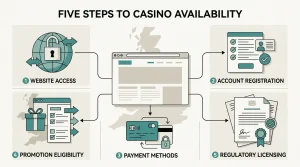


An offer’s value depends on its qualifying deposit, how bonus funds are credited, and the conditions attached to each component.
How an Online First-Deposit Offer Is Presented
An online first-deposit offer is a package of terms attached to the opening transaction, not a cash figure in isolation. Its headline may state a bonus amount or describe an additional feature, but that wording does not establish what a customer will receive, what must be done before any balance can be withdrawn, or which parts of the offer are subject to separate rules. A useful description makes those distinctions visible before registration and deposit.
For a first-deposit bonus at a UK online casino, the starting point is the offer’s full terms, not the promotional label. The description should identify what qualifies as the offer, what action triggers it, and which account balance receives any resulting credit. It should also make clear whether the advertised package contains one component or several. If distinct components have different conditions, presenting them as one undifferentiated headline makes comparison harder rather than easier.
The key test is whether the information allows the offer to be assessed before money is committed. A clear presentation identifies the qualifying deposit, the bonus calculation or stated amount, any maximum credit, and the conditions attached to use and withdrawal. Those details determine the practical result. A prominent figure without its qualifying basis is incomplete; so is a percentage without the cap that limits the credited amount. These are not decorative footnotes. They are parts of the calculation.
A first-deposit offer is worth assessing alongside the practical details of using a casino. Check the applicable bonus terms and payout information before deciding.
1. EvoSpin
Payout speed: 1-3 business days EvoSpin lists a payout speed of 1–3 business days, a practical detail to consider when reviewing its first-deposit offer.
2. SpinFormula
Payout speed: 1-3 business days SpinFormula lists a payout speed of 1–3 business days. Keep this timing in mind when weighing its first-deposit offer.
3. Zombillion
Payout speed: 1-3 business days Zombillion lists a payout speed of 1–3 business days, giving readers a stated timeframe to consider alongside its first-deposit offer.
4. BeOnBet
Payout speed: 1-3 business days BeOnBet lists a payout speed of 1–3 business days. This is a useful detail to review when considering a first deposit.
5. Jetsetspins
Payout speed: 1-3 business days Jetsetspins lists a payout speed of 1–3 business days, which readers can factor into their assessment of its first-deposit offer.
6. Revery Play
Payout speed: 1-3 business days Revery Play lists a payout speed of 1–3 business days. Consider this stated timing when reviewing its first-deposit offer.
7. NightWin
Payout speed: 1-3 business days NightWin lists a payout speed of 1–3 business days, a relevant practical detail for readers considering a first deposit.
8. Chanze
Payout speed: 1-3 business days Chanze lists a payout speed of 1–3 business days. Readers can take this timing into account when assessing its first-deposit offer.
9. SlotoSport
Payout speed: 1-3 business days SlotoSport lists a payout speed of 1–3 business days, providing a stated timeframe to consider alongside its first-deposit offer.
10. Amunbet
Payout speed: 1-3 business days Amunbet lists a payout speed of 1–3 business days. This timing is worth keeping in mind when considering a first deposit.
A description also needs to distinguish the customer’s own deposited funds from promotional credit. The two may appear together in an account, but that does not by itself mean they have the same status or can be withdrawn on the same terms. Any difference in how the balances are treated should be stated plainly. Where a feature is restricted to particular games, or a bonus element is governed by its own rules, the description should identify that scope rather than imply that the full offer applies everywhere in the casino.
The same principle applies to release conditions. A headline can describe credit granted at the start, while the withdrawal terms determine what becomes available later. Those are separate stages and should not be collapsed into a single promise of value. The offer page needs to state any play-through requirement, eligible contribution rules, expiry condition, or other restriction that affects whether promotional credit can be converted into withdrawable funds. If a term is absent from the main summary, it should still be easy to locate in the full rules. The reader should not have to infer a condition from promotional wording.
High-Volatility Slots in the UK: How Payouts Work
Presentation matters because a first deposit creates a financial commitment before the offer’s eventual value is known. The amount credited is only one part of that value. A fair comparison also considers the deposit required to qualify, the rules governing the credit, any eligible-game restriction and the route from bonus balance to withdrawal. A large headline may therefore describe a larger nominal offer without establishing that it is more useful. The arithmetic depends on the conditions, not the adjective attached to the offer.
In the UK, real-money online casino gambling is legal only through operators holding the relevant UK Gambling Commission licence. Operators serving customers in Great Britain must hold that licence, wherever the business is based. Customers must be at least 18, and an operator must verify age before allowing a deposit. A bonus description does not replace those requirements. Licensed operators must also provide access to responsible-gambling tools, including self-exclusion, and account controls should be considered alongside the offer rather than treated as unrelated site information.
Deposit methods have restrictions too. UK-licensed casinos cannot accept credit cards for gambling, including credit-card funding routed through a money service business, and cannot accept wallet payments where the wallet allows credit-card funds to be used for gambling. Before a first deposit, a remote operator must prompt a new customer to set a financial limit and provide accessible account-level limit controls. These rules shape the transaction around the bonus: the promotional terms are not the only conditions governing the money entering the account.
UK Licensing
Real-money online casino gambling in Great Britain is legal only through operators holding a relevant UK Gambling Commission licence.
A casino offer page should therefore be read as a set of linked disclosures: what triggers the offer, what is credited, how the credit is treated, what restrictions apply, and what must happen before funds can be withdrawn. It should also separate promotional language from binding terms. “Up to” wording, where used, describes a ceiling rather than a guaranteed payment; a stated maximum does not show what a particular deposit qualifies for. The amount that matters is the amount produced by the customer’s qualifying transaction under the stated rules.
The underlying game remains relevant to the value of any casino balance. Keno outcomes are random, payouts differ across platforms, and the game’s specific rules, paytable and odds should be checked before wagering. A specialist review has reported keno house edges of 25% or more; a bonus does not remove that edge or make an outcome predictable. Selecting particular spots cannot influence a legitimate game’s draw, and no strategy guarantees a win. This is a separate calculation from the offer itself, but it belongs in any assessment of what credited funds may be used to play.
The most informative first-deposit presentation is consequently not the one with the boldest headline. It is the one that lets the amount, restrictions and withdrawal conditions be understood before the deposit is made. When those elements are separated clearly, the offer can be assessed on its actual terms rather than on the promotional figure alone.
Fast Payout Online Casinos in the UK: What to Check
The Conditions Attached to a First Casino Deposit
A first-deposit offer is not a single credit with a single value. It is a set of conditions that determines who qualifies, what is added to the account, where that amount can be used and what must happen before any resulting balance can be withdrawn. The headline describes only part of that arrangement. The useful comparison is between the offer as advertised and the balance available after each condition has been applied.
The terms should be read as one sequence. First comes eligibility: whether the account and deposit qualify. Next comes the calculation of any bonus credit or other component. Then come restrictions on use, play and withdrawal. A condition at the beginning can make the later terms irrelevant; a deposit that does not qualify cannot produce the advertised credit, however attractive the rest of the offer appears.
The wording must also distinguish a deposit from bonus funds. A deposit is money paid into the account; promotional credit is provided under the offer’s rules. They may appear together in an account balance, but that does not establish that they are treated alike. The terms should explain which balance is available for which activity and what happens to any promotional amount if the offer is not completed or is declined. If those points are unclear, the displayed total is not a reliable measure of immediately usable money.
A complete assessment therefore needs more than a headline amount. It needs the qualifying action, the amount or form of credit, the eligible games or activity, any play-through or release conditions, the withdrawal rules, and the treatment of unused or forfeited promotional funds. These details should be available in the offer terms before a deposit is made. A condition hidden behind a general link is still a condition; it does not become less consequential because it is less prominent.
Do
- Read the offer’s full terms before depositing
- Distinguish between deposited funds and promotional credit
- Check the specific game’s paytable and odds
Don’t
- Rely solely on a promotional headline amount
- Assume a broad reference to casino play includes all games
- Infer conditions from promotional wording
Timing can matter without changing the size of the offer. Terms may specify when an offer must be activated, when a qualifying deposit must be made, or how long a credited benefit remains available. Those are separate questions. Activation is not the same as eligibility, and crediting an offer is not the same as making its value withdrawable. The relevant text should identify the events that start or end each stage, rather than leaving the account holder to infer them from a balance display.
The same care applies to restrictions that affect practical use. A bonus may be limited to particular games, or different activity may contribute differently towards a condition. The offer should state the scope clearly enough to identify what counts and what does not. A broad reference to casino play does not, by itself, establish that every game is eligible. Where an offer involves keno, its payouts vary between platforms, so the specific game’s paytable, rules and odds need checking before wagering. Keno carries a house edge of at least 25%; no choice of spots or system removes that mathematical disadvantage.
Legal and account conditions sit alongside promotional terms. In Great Britain, a remote operator serving customers must hold the relevant UK Gambling Commission licence. Online gambling is legal for adults aged 18 and over when the operator holds that licence, and operators must verify age before allowing a customer to deposit. A new customer must also be prompted to set a financial limit before the first deposit, with account-level limit controls available. These protections are not bonus enhancements; they are part of the operating conditions surrounding the account.
Highest RTP Slots in the UK: How to Compare Games
Payment method is another practical boundary. UK-licensed casinos cannot accept credit cards for gambling, including credit-card funding routed through a money service business. They also cannot accept wallet payments where the wallet permits credit-card funds to be used for gambling. A promotional offer does not override those restrictions, so a payment method’s apparent convenience cannot make it eligible where gambling rules prohibit it.
A first deposit bonus casino offer should also be assessed against its account and dispute provisions, not only its promotional wording. UKGC licensees must provide an internal complaints process and access to an approved Alternative Dispute Resolution service. They must also provide responsible-gambling tools, including self-exclusion. Those arrangements do not alter the amount credited, but they define the safeguards and recourse attached to the account.
The practical test is documentary: can the terms explain what qualifies, what is credited, how that credit may be used, and what conditions affect access to the resulting balance? If not, the headline cannot settle the question. A first deposit bonus is assessable only when the full path from deposit to usable or withdrawable funds is stated clearly.
How Deposit-Match Percentages and Caps Affect the Bonus
A deposit-match percentage describes how the bonus is calculated against a qualifying deposit. It does not, on its own, state the amount that will be credited. That depends on the percentage, the deposit that meets the offer’s rules and any cap on the bonus.
The calculation can be represented as:
Bonus = qualifying deposit × match rate, subject to the stated cap.
Bonus Calculation
Step 1: Identify the Match
Apply the match rate (percentage) to the qualifying deposit amount.
Step 2: Compare with the Cap
Check if the calculated amount exceeds the stated maximum bonus cap.
Step 3: Determine Final Credit
Take the smaller of the two figures: the calculated match or the cap.
If the calculated match is below the cap, the percentage determines the bonus. If it exceeds the cap, the cap limits the credit. The advertised rate and the maximum bonus therefore describe different parts of the offer: one sets the calculation, the other restricts its result.
A full deposit match means the bonus equals the qualifying deposit before any cap is applied. A higher match rate can produce a larger calculated bonus, but only while the cap allows it. Once the cap is reached, depositing more does not increase the bonus under that offer. The rate may remain prominent in the headline; the cap does the limiting.
The qualifying deposit also matters. The amount entered into a payment form is not necessarily the amount used in the calculation if the offer defines eligibility in narrower terms. The offer’s wording should make clear which deposit counts and whether the stated match applies to all of it. Without that information, a headline percentage cannot be translated into a reliable credit amount.
A useful comparison starts with the deposit that would actually qualify, rather than the largest deposit the headline might suggest. Apply the match rate to that amount, then compare the result with the cap. The smaller figure is the maximum bonus implied by those two parts of the offer. This calculation separates the stated rate from the amount that can be credited; neither should be read in isolation.
Where the cap is low relative to the qualifying deposit, the rate may have little practical effect. Where the cap is not reached, the rate has more influence on the credited amount. These are not separate promises: the payable bonus is governed by both terms together. A percentage alone cannot establish the bonus, and a cap alone cannot show what a particular qualifying deposit would produce.
Bonus buy slots in the UK: demos, costs and limits
The wording should also distinguish the deposit from the bonus. A match is an additional credit calculated from the qualifying deposit, not a reduction in the amount deposited. The total balance after crediting may therefore combine the customer’s deposit and the bonus, but that combined balance is not the same as the bonus amount. Keeping those figures separate prevents a larger displayed balance from being mistaken for a larger match.
For a UK offer, the operator must hold the relevant Gambling Commission licence to provide remote gambling to customers in Great Britain. That regulatory status does not change the arithmetic of a match, but it is part of assessing who is offering it. The calculation itself still rests on the offer’s qualifying-deposit definition, stated rate and cap.
A clear offer lets those terms be read together and checked before depositing. If a headline gives a percentage but the cap or qualifying deposit is unclear, the resulting credit cannot be calculated with confidence. The headline is then a rate without a usable outcome—an incomplete piece of arithmetic.
When a First-Deposit Bonus Is Restricted to Slots
A first-deposit bonus limited to slots is usable only under the game-eligibility rules attached to the offer. The label does not establish which titles qualify, whether every slot is included, or how a bonus balance can be used. Those details belong in the offer terms and the casino’s game rules. Without them, the headline describes a category, not the practical scope of the promotion.
Slot Regulations
In Britain, online slot spins must last at least 2.5 seconds, autoplay is banned, and maximum stakes are capped at £5 for adults 25+ and £2 for those aged 18 to 24.
The first check is the list or definition of eligible games. Some terms may identify particular titles; others may describe a broader group. A broad label should not be treated as proof that every game in the casino lobby is eligible. If a preferred slot is excluded, the bonus may have little relevance to the games a player intended to play. If eligibility is unclear, its value cannot be assessed reliably.
Game eligibility matters because a slot-only restriction narrows where the promotional balance can be used. It does not, by itself, establish the bonus amount, how it is released, or whether winnings can be withdrawn. Those are separate terms. The useful comparison is between the games permitted by the offer and the games the customer is willing to play, followed by a review of any conditions that apply to the balance and resulting winnings. A large headline figure cannot compensate for a game restriction that makes the offer unusable in practice.
The distinction between cash deposited and promotional credit also matters when reading the rules. The terms should make clear which balance is available for which games and whether the restriction applies to the deposit, the bonus, or both. If that is not stated clearly, the apparent scope of the offer remains uncertain. The safest assessment is based on the written eligibility rules rather than the promotional label or a general description of the casino’s slots.
Slot eligibility should not be confused with the slot’s own return or rules. Each game has its own information, and a bonus label is not evidence that a particular slot offers better odds. In Britain, online slot spins must last at least 2.5 seconds, autoplay is banned, and the maximum stake per game cycle is £5 for adults aged 25 and over and £2 for those aged 18 to 24. These rules govern play; they do not expand the list of games eligible for a promotion.
The casino must verify a customer’s age before allowing a deposit. UK-licensed operators must also prompt new customers to set a financial limit before their first deposit and provide accessible account-level limit controls. These protections do not change the bonus calculation, but they are part of the conditions surrounding access to real-money play.
Low-Volatility Slots UK: Payout Patterns Explained
For comparison, a slot-only offer should be judged on the eligible games and the restrictions attached to its bonus balance, not on the size of its headline alone. Keno is a separate game category, not a substitute for an eligible slot; a specialist review reports that keno house edges can reach 25% or more. Keno payouts vary by platform, so its specific paytable, rules and odds should be checked before wagering.
Free Spins as Part of a First-Deposit Offer
Free spins can form part of a first-deposit offer, either alongside a cash match or as a separate promotional component. They should be assessed separately: a headline that combines spins and cash does not mean the two have the same conditions, apply to the same games or become withdrawable in the same way.
The key detail is the game eligibility rule. An offer may restrict spins to named slots or another defined group of games. If the eligible games are not stated clearly, the value of the spins cannot be assessed from the headline alone. A game’s own rules and paytable determine how its outcomes are calculated; payouts and rules can vary between platforms. Checking the specific game’s paytable, rules and odds before wagering is therefore part of assessing the offer, not an optional extra.
The spin stake and the treatment of any resulting winnings also matter. The terms should make clear what happens to winnings, whether they are credited as cash or remain subject to bonus conditions, and whether any restrictions apply to using or withdrawing them. A free spin has no fixed cash value: its result depends on the game outcome and the terms governing that result. Counting each spin as though it were cash would turn a promotional label into a balance that may not exist.
Timing and eligibility should be checked in the offer terms as well. The description needs to say what deposit qualifies, when the spins are credited, and whether there is a period in which they must be used. Where those details are unclear, the advertised quantity alone is not enough to compare the offer with a cash-only bonus. The important figure is not simply the number of spins, but what conditions apply before any resulting balance can be treated as available funds.
3-Reel Slots in the UK: How the Format Works
A first-deposit bonus with free spins may also differ from a promotion described only as free spins on a first deposit. In either case, the cash-match terms and the spin terms should be read as separate parts of the offer. A match calculation does not establish which games accept the spins; spin eligibility does not establish how a cash bonus is released. Combining the two in one headline does not combine their rules.
The same scrutiny applies where a promotion is associated with a crypto casino or a small qualifying deposit. Payment method and deposit size do not, by themselves, establish the promotion’s eligibility or the value of its spins. Remote gambling operators serving Great Britain must hold the relevant UK Gambling Commission licence; an offshore casino does not become UK-licensed by advertising to UK players. An offer’s presentation is packaging. Its usable value depends on the written terms attached to each component.
What “No Wagering” Means for a Deposit Bonus
A no-wagering claim concerns the amount of play required before bonus funds can be withdrawn. If a bonus has a wagering requirement, the terms set a turnover target: eligible bets must reach that target before the bonus, or winnings linked to it, become withdrawable. A no-wagering offer says that this turnover condition does not apply. It does not, by itself, establish that every credited amount is immediately available as cash.
The distinction between the balance shown and the balance that can leave the account matters. A bonus may appear alongside deposited funds, while the casino’s rules treat the two amounts differently. The decisive wording is whether the no-wagering statement covers the bonus itself, winnings generated from it, or both. A headline can be accurate within its stated scope and still leave other release conditions in place.
For a first deposit bonus casino offer described as no wagering, the useful comparison is therefore not just the displayed credit. It is the amount that the terms make withdrawable, and the steps required to reach that point. The terms should state whether a withdrawal request removes bonus funds or affects related winnings. If the offer is available only under particular conditions, those conditions need to be read alongside the no-wagering claim rather than treated as a contradiction or ignored as small print.
5-Reel Slots in the UK: Bets, Demos and Features
“No wagering” should not be read as “no conditions”. An offer can still have rules about eligibility, activation, qualifying play or the treatment of a balance when a withdrawal is requested. Those rules are separate from turnover. The wording should make clear what happens to the bonus and any associated winnings; if it does not, the claim alone is not enough to calculate the final withdrawable amount.
This is why first deposit bonus casinos with no wagering cannot be compared on the label alone. One offer may remove a turnover hurdle while another may describe the scope of its exemption differently. The relevant test is whether the terms impose any play-through requirement on the bonus or its winnings, and what remains available after the casino applies the rest of its rules.
For UK players, real-money online casinos must hold a UK Gambling Commission licence. The operator must verify age before allowing a deposit, and UK-licensed casinos must provide responsible-gambling tools, including self-exclusion. Those protections do not change the meaning of “no wagering”; they sit alongside the offer terms. The financial comparison still turns on the precise release conditions, not on the most reassuring phrase in the promotion.
Fastest Payout Online Casinos UK: What It Means
Comparing the Terms of Casino Deposit Bonuses
A useful comparison of casino first-deposit bonuses starts with the full offer, not its largest advertised figure. Two offers can use similar headline language while crediting different things or attaching different conditions. The comparison is only meaningful when each term is recorded alongside the amount it qualifies.
A compact checklist keeps the components separate:
- Qualifying deposit: what must be deposited for the offer to apply, and whether the entire deposit or only a defined part qualifies.
- Bonus format: whether the offer adds bonus funds, free spins or another stated benefit. These are not interchangeable: a stated bonus amount is not automatically cash available to withdraw.
- Eligibility: whether the offer is limited to particular games, including any distinction between standard casino games and live casino games.
- Release and use conditions: what must happen before credited funds or winnings can be withdrawn, and which restrictions apply while the offer is active.
- Timing: any stated period for claiming or using the offer, and what happens if that period ends.
- Account and payment requirements: whether the terms specify how the qualifying deposit must be made and what account conditions apply.
The checklist is not a substitute for the offer’s full terms. It is a way to expose missing comparisons: a larger headline may be less relevant if it applies to a narrower set of games or carries more restrictive conditions. Conversely, an offer with a smaller headline cannot be judged on that figure alone. The relevant comparison is what the stated terms allow the customer to receive and what must be done before any resulting balance can be withdrawn.
For a live casino offer, game eligibility deserves particular attention. A casino-wide label does not, by itself, establish that live games qualify. The terms need to say which games are included and whether different conditions apply to them. The same principle applies to any bonus component: the label describes the packaging; eligibility and restrictions determine its practical scope.
The UK context also sets a basic boundary. Real-money online casinos serving Great Britain must hold the relevant UK Gambling Commission licence, and operators must verify age before allowing deposits. New customers must be prompted to set a financial limit before their first deposit, with account-level controls available. A comparison should therefore concern the terms of a UK-licensed offer, rather than treating an advertised bonus as detached from the operator’s obligations.
Bonus Comparison
- Verify the qualifying deposit amount
- Check the bonus format (funds or spins)
- Confirm game eligibility and restrictions
- Review release and withdrawal conditions
- Check the claim and usage timeframe
- Confirm the operator holds a UKGC licence
A fair comparison records each offer’s headline and qualifying conditions in adjacent columns. If a condition changes what can be credited, used or withdrawn, it belongs beside the figure—not in small print mentally filed as someone else’s problem.
The Welcome Bonus and Its First-Deposit Terms
A welcome bonus is an introductory offer attached to a new customer’s account. The label describes its place in the customer relationship, not the amount that will be credited or the conditions for using it. A first-deposit welcome bonus applies when the qualifying initial payment meets the offer’s stated rules; the headline alone does not establish what the account receives.
The useful comparison is between the offer’s wording and the transaction it requires. The terms should make clear which deposit qualifies, how the bonus is credited, and whether any additional components are included. If the description leaves the qualifying action unclear, the advertised welcome amount cannot be assessed reliably. A bonus is not a cash equivalent merely because it appears beside a deposit figure.
This distinction also matters when an offer is described as the best first-deposit welcome bonus at a UK casino. “Best” has no fixed financial meaning without a consistent basis for comparison. A larger headline may come with conditions that affect how much of the offer can be used or withdrawn; a smaller one may have a different structure. The relevant figure is therefore not the largest number in an advert, but the amount that the stated terms make available under the qualifying transaction.
Welcome offers should also be read as account terms, not as a substitute for the operator’s broader responsibilities. In Great Britain, remote gambling operators serving customers must hold the relevant UK Gambling Commission licence. Operators must verify age before permitting deposits, and new customers must be prompted to set a financial limit before their first deposit, with account-level controls available. UK-licensed casinos cannot accept credit cards for gambling.
Progressive Jackpot Slots: How Shared Pools Work
The offer itself does not change the underlying odds of a game. Keno payouts vary between platforms, and a specialist review reports that its house edge can reach 25% or more. Keno outcomes are random; a bonus does not make a number choice more likely to win. Before wagering on keno, the game’s specific paytable, rules and odds need to be checked.
A welcome bonus is therefore best understood as a conditional account credit, not as an immediate reduction in the cost of gambling. Its first-deposit wording determines whether the payment qualifies; the attached terms determine what follows. Without both pieces, the headline is packaging, not a usable valuation.
Assessing a Large Headline Bonus Against Its Conditions
A large advertised first-deposit bonus is a starting figure, not a measure of what a customer will receive. Its value depends on the deposit required to qualify, the maximum bonus available and the conditions attached to the offer. Without those details, the headline cannot be compared fairly with another casino’s promotion.
The qualifying deposit determines whether the offer is accessible at all. A bonus may be advertised prominently but require a deposit beyond the amount someone intended to spend. The cap matters too: once the maximum has been reached, depositing more does not necessarily produce a larger bonus. The calculation should therefore stop at the stated cap rather than assume the headline grows in proportion to the deposit.
The next question is what the credited bonus permits. Terms may restrict eligible games or set conditions for releasing bonus funds. Those rules affect how much of the advertised amount can become withdrawable and when. A headline number that looks substantial can have limited practical value if the attached conditions are difficult to meet or do not suit the intended play.
A useful comparison separates the cash deposited from the bonus credited, then checks the qualifying amount, cap and release conditions. The advertised total should not be treated as cash already available for withdrawal. If the terms do not make clear how the offer is calculated or what happens to unused bonus funds, its value cannot be assessed from the headline alone.
UK Slot Sites: Licensing, RTP and Bonus Terms
In Britain, licensed operators must prompt new customers to set a financial limit before their first deposit and provide account-level limit controls. A promotion does not alter that safeguard or make a larger deposit financially neutral. Keno is a separate game consideration: its house edge can be 25% or more, so its paytable, rules and odds should be checked before wagering; payouts vary between platforms. Keno’s mechanics do not increase the value of a casino deposit offer.
For a casino with a first-deposit promotion, the defensible comparison is the amount that qualifies, the amount credited within the cap and the conditions governing its use. The biggest headline is not automatically the strongest offer; it is only the largest figure before the calculation begins.
First-Time Deposits and Bonus Eligibility
A first deposit is a timing point, not a guarantee of bonus eligibility. The offer terms determine whether eligibility attaches to the first payment into an account, to a new customer, or to another defined event. Those descriptions are not interchangeable: someone making a first payment may not meet an offer’s separate customer-eligibility rules.
The timing matters because a deposit made before an offer is claimed or activated may be treated differently from one made while the offer is available. The terms should therefore be checked before the initial payment, including any wording on who qualifies and when the offer must be selected. A later deposit should not be assumed to qualify simply because the account has not previously received a bonus.
This distinction also separates first-deposit offers from promotions that apply to later payments. The relevant question is not only whether the payment is the first one, but whether the account meets the offer’s stated eligibility conditions at that point. If the wording is unclear, the operator’s terms or customer service should clarify it before money is deposited; after the event, the payment may already have been processed under different terms.
In the UK, a remote casino serving Great Britain must hold a UK Gambling Commission licence. Operators must verify age before allowing deposits, and must prompt new customers to set a financial limit before their first deposit. These requirements concern access and account controls; they do not themselves establish eligibility for a particular bonus.
How do you play Keno?
Choose numbers on the Keno card, place a bet, and wait for the random draw. Winnings depend on how many of your numbers match the drawn numbers.
How many numbers can I choose in Keno?
It varies by game: many let you choose up to 10–15 numbers, while some allow up to 20. Check the game’s rules before playing.
How is Keno betting done?
Select your numbers and bet size before the draw; some games also let you reuse the same selection across multiple games or add side bets. Payouts depend on your number of selections and how many match.
How do I choose a line and place a bet?
Select numbers on the Keno card, either manually or using random selection, then choose your stake before the draw. The available number of selections and betting options depend on the game.
How important is it to pick the right Keno game?
It matters because rules, paytables and house edges vary between games. Check the paytable and choose a game with stakes that fit your budget; number choices do not affect the random draw.
Is the payout guaranteed?
No. Keno outcomes are random, and whether you win—and how much—depends on how many selected numbers match the draw and the game’s paytable.
What is the house edge in Keno?
It can range from 5% to 40%, depending on the casino, and online games usually have a higher edge. Check the specific game’s paytable and rules.
Material created by the team Jettbet