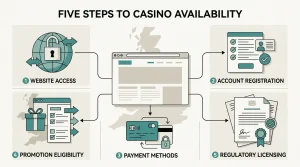


A Curaçao licensing connection is not UKGC approval; the distinction matters when assessing access, payments and safeguards.
What “Curacao Casino” Means for UK Players
“Curacao casino” describes a casino by reference to its licensing jurisdiction. It does not mean that the site is regulated by the UK Gambling Commission (UKGC). A Curacao online casino belongs to the broader category of non-UK-regulated casinos: online gambling sites that operate without UKGC oversight and are typically licensed by another jurisdiction.
The distinction is about regulation, not necessarily where a company is based or where its website can be accessed. The phrase “online casino in Curaçao” can sound as though the casino itself is physically located there. In practice, the label points to a licensing connection. It is not, by itself, a complete description of the operator, its ownership or the countries in which it offers services.
For UK readers, that distinction prevents a common category error. A casino may refer to Curaçao in its licensing information, but that does not make it a UKGC-regulated casino. The words describe different regulatory connections. “Curaçao-licensed” and “UKGC-licensed” are not interchangeable labels, and a foreign jurisdiction’s name should not be read as a UK approval.
For UK readers looking into Curaçao-licensed casinos in 2026, it is important to check the information available for each operator rather than assume licensing details. The available detail here is payout speed, which can help inform your review but does not establish an operator’s licensing status.
1. EvoSpin
Payout speed: 1-3 business days EvoSpin lists a payout speed of 1–3 business days.
2. SpinFormula
Payout speed: 1-3 business days SpinFormula lists a payout speed of 1–3 business days.
3. Zombillion
Payout speed: 1-3 business days Zombillion lists a payout speed of 1–3 business days.
4. BeOnBet
Payout speed: 1-3 business days BeOnBet lists a payout speed of 1–3 business days.
5. Jetsetspins
Payout speed: 1-3 business days Jetsetspins lists a payout speed of 1–3 business days.
6. Revery Play
Payout speed: 1-3 business days Revery Play lists a payout speed of 1–3 business days.
7. NightWin
Payout speed: 1-3 business days NightWin lists a payout speed of 1–3 business days.
8. Chanze
Payout speed: 1-3 business days Chanze lists a payout speed of 1–3 business days.
9. SlotoSport
Payout speed: 1-3 business days SlotoSport lists a payout speed of 1–3 business days.
10. Amunbet
Payout speed: 1-3 business days Amunbet lists a payout speed of 1–3 business days.
Curaçao is one jurisdiction, not a general term for foreign casinos
Curaçao is one of several jurisdictions associated with licensing non-UK-regulated casinos. Malta, Gibraltar and Anjouan are also among the jurisdictions that may license sites outside UKGC oversight. They are separate places and regulatory systems, not different names for the same licence.
That matters when a casino is described loosely as “offshore” or “international”. Those words may indicate that the operator sits outside the UK regulatory system, but they do not identify which jurisdiction is connected to the site. A Curaçao label is more specific than “foreign casino”; it names one jurisdiction. It still does not answer every question about the operator.
The same distinction applies to wording such as “Curacao casinos online” or “casino online in Curaçao”. These are ways of describing casinos associated with Curaçao licensing, rather than a separate category of games or a special kind of casino product. The games may be familiar; the descriptor concerns the regulatory context attached to the site.
What the label can and cannot tell
The label gives a starting point for understanding how a site presents its regulatory status. It does not, on its own, establish that the operator is authorised by the UKGC, nor does it make Curaçao a synonym for all non-UK-regulated casinos. A Malta-licensed site and a site associated with Curaçao may both sit outside UKGC oversight, while remaining distinct in their licensing jurisdiction.
Casino Without a Swedish Licence: UK Regulation
Nor should the phrase “Curacao online casino UK” be read as evidence of a UK licence. “UK” may refer to the intended audience or to the wording used to describe a site; the jurisdiction named in the licensing description remains Curaçao. The terms answer different questions. One refers to a market or audience; the other identifies a licensing connection.
This is why broad labels such as “best Curaçao online casinos” can obscure the first point that matters: “Curaçao” is not a quality grade. It does not, by itself, establish that one site is better than another, or that a site has the same regulatory status as a UKGC-licensed operator. A ranking based only on the jurisdiction in a headline would confuse a location with an assessment.
The wording on a site can also vary. “Curaçao casino”, “Curaçao-licensed casino” and “casino licensed in Curaçao” may all be used to describe the same general connection. The clearest version is the one that names the jurisdiction without suggesting UKGC regulation. Conversely, calling a site simply a “UK casino” can leave the licensing distinction unclear if the description does not say which regulator oversees it.
In short, “Curaçao casino” is a jurisdictional description, not a synonym for “UK-regulated casino” and not a catch-all for every non-UK-regulated site. Curaçao is one of several jurisdictions associated with such casinos; Malta, Gibraltar and Anjouan are others. Keeping those terms separate makes the label easier to interpret without attributing to it more than it says.
Non-UK Licence Casinos: What Their Approval Means
UK Law and the Limits of an Offshore Licence
A Curacao casino licence and a UK Gambling Commission licence have different legal functions. A licence issued in Curaçao does not meet the requirement for a UKGC licence when an operator supplies gambling services to customers in Great Britain. The operator’s place of registration does not change that requirement: the relevant question is whether it is serving the British market.
The Gambling Act 2005 places the regulatory obligation on the operator, rather than making the individual player responsible for holding a licence. In practical legal terms, an overseas authorisation cannot be treated as permission for an operator to serve Great Britain under UK rules. A site may describe itself as licensed abroad, but that description does not turn its licence into UKGC authorisation.
That distinction matters because two different questions are often collapsed into one: whether an operator is authorised to provide gambling services in Great Britain, and whether a British citizen commits an offence by using a service licensed elsewhere. The first concerns the operator’s regulatory position. The second concerns the player’s legal liability. The rules do not impose the operator’s UK licensing duty on the player.
UK law does not set out a general prohibition on British citizens using gambling services authorised in another country. Nor does a player commit a criminal offence merely by gambling on a site that lacks a UK licence. That does not make an overseas licence equivalent to a UK one, or establish that the operator is entitled to serve customers in Great Britain. It means the licensing obligation and the player’s potential criminal liability are separate matters.
Merkur Casino Online in the UK: Games and Access
The distinction also prevents a misleading reading of phrases such as “Curacao casinos UK” or “UK Curacao casinos”. Those labels may describe a site’s claimed licensing jurisdiction or intended audience; they do not establish its regulatory status in Great Britain. A Curacao casino licence is not a substitute for the UK Gambling Commission licence required of operators supplying the British market.
The position is therefore not that every gambling service carrying a foreign licence is authorised for Britain, nor that an individual player is prosecuted simply for using one. The operator’s obligation remains with the operator. The player’s lack of criminal liability does not confer UK approval on the service, and an overseas licence does not remove the requirement that applies to operators serving Great Britain.
For the UK legal framework, “offshore” is not a special exemption. A business does not escape the British licensing requirement by being based abroad or by holding a licence from another jurisdiction. Conversely, that requirement should not be recast as a criminal rule directed at the player. Keeping those points separate gives the accurate answer to what a Curacao casino licence means in the UK: it identifies an overseas authorisation, not a UK Gambling Commission licence, while the UK licensing duty falls on operators supplying the British market.
What a Licence Does—and Does Not—Verify
A Curacao gaming licence and a UK Gambling Commission licence are not interchangeable credentials. A casino may display a foreign licence and still have no UKGC authorisation. The licence name, badge or certificate on a website does not change that distinction, and a Curacao casino rating cannot establish that an operator is approved to serve Great Britain.
A Curacao casino rating or a displayed licence badge does not establish that an operator is approved to serve Great Britain.
The same check applies to claims about Curacao eGaming casinos: the stated regulator and the operator’s status need to be treated as separate questions. A licence claim concerns the jurisdiction named on the licence. UKGC authorisation concerns permission to serve the British market. One does not prove the other, so “licensed” is not a complete description of a casino’s regulatory position.
For an Anjouan casino, verification should be specific rather than inferred from a logo. Check the authority’s public register for an entry that corresponds to the operator, confirm that the licence has not expired, and compare the registered company name with the company identified in the casino’s terms. A mismatch matters: a licence issued to one legal entity should not be treated as evidence that a different company holds it. If the entry, date or company details cannot be reconciled, the claim has not been verified.
Those checks answer whether the stated Anjouan credential appears to match the operator. They do not turn it into UK approval. Anjouan authorisation does not permit the operator to serve markets where it is restricted, including the United Kingdom. Nor does an Anjouan licence require the casino to join GAMSTOP or provide an independent dispute-resolution route equivalent to UKGC-approved services. These are features of the Anjouan framework, not claims about Curacao licensing.
The distinction also limits what a licence can establish. It does not, by itself, prove that a site is safe, that every advertised term will be applied favourably, or that a UK regulator can intervene in a dispute. A certificate can support a narrow claim about the named licence and company when its details match; it cannot stand in for a separate check of British regulatory status. “Licensed” is a starting point for identifying who claims oversight, not a universal quality mark.
USA Casinos for UK Players: Regulation and Risks
Checking Licence Claims Without Treating Them as a UK Approval
A licence claim has two separate parts: whether an operator is licensed somewhere, and whether it holds the authorisation required for the British market. The first does not establish the second. A casino describing itself as Curaçao-licensed is claiming a connection to that jurisdiction, not UK Gambling Commission approval.
That distinction matters when comparing Curacao licensed casinos or reading a casino review. Terms such as “licensed”, “regulated” and “approved” can appear together in promotional copy, but they are not interchangeable. A foreign licence does not place a site under UKGC oversight. Non-UK-regulated casinos operate without that Commission’s oversight, even when they hold a licence from another jurisdiction.
A sensible assessment starts with the exact wording of the claim. Does it identify a licensing jurisdiction, or does it merely use a badge or a general assurance that the casino is regulated? Does the claim name the operating company, or only the brand? A logo on a footer is not, by itself, evidence of what entity holds a licence or what that licence covers.
The company name is particularly important. A casino brand may not be the legal name of the operator. If a licence document or regulator reference is provided, the names and details should be consistent with the entity running the gambling service. If the claim cannot be tied clearly to that operator, its practical value is limited. This is a way to assess the claim, not a substitute for confirming UK authorisation.
Do
- Check if the licensing jurisdiction is explicitly named
- Verify the operating company matches the licence holder
- Match the regulator’s public register entry to the operator
Don’t
- Treat a footer logo as evidence of licensing
- Assume a brand name is the legal entity holding the licence
- Use a general “regulated” claim as proof of UK authorisation
A Curacao casino list assembled by a review site also needs careful reading. Inclusion in a list may mean only that the site’s publisher has classified the casino as linked to Curaçao. It does not establish that each entry has a current licence, that the licence covers the relevant activity, or that the operator is authorised in Britain. The same applies to labels such as “Curacao slot”: the game or category name says nothing about the operator’s UK regulatory status.
Payment branding is separate too. A mention of Paysafecard, or any other payment option, cannot verify a casino’s licence. Payment availability describes a transaction route; it does not prove who regulates the operator. Reviews can help identify what a site claims about its licensing, but a review is not a regulator’s decision.
The broader context is that non-UK-regulated casinos may be licensed by different jurisdictions, including Malta, Curaçao, Gibraltar or Anjouan. Those are distinct licensing systems. A licence from one jurisdiction should not be treated as evidence of authorisation from another, and the word “offshore” does not identify a single regulator or standard.
So, is a Curacao casino safe? The licence label alone cannot settle that question. It can indicate the jurisdiction an operator says is responsible for licensing it, but it does not amount to a UK approval or establish the full protections available to a customer. A list, review, badge or payment logo may provide clues; none changes the regulatory meaning of the licence claim.
When an Offshore Casino Says It Accepts UK Players
A statement that a Curacao casino accepts customers from the UK describes the operator’s position on access. It does not establish that the operator is authorised to provide gambling services in Great Britain. These are separate tests: a site may be reachable, allow account registration or process a deposit, while still lacking the permission required to serve the British market.
For operators serving customers in Great Britain, the relevant authorisation is a licence from the UK Gambling Commission. The operator’s location does not change that requirement. A licence issued in Curaçao is not a substitute for a UK Gambling Commission licence, and wording such as “UK players welcome” cannot change the regulatory status.
Regulatory Status
A Curacao licence is not a substitute for the UK Gambling Commission licence required of operators supplying the British market.
The distinction matters when a site’s terms, registration form or promotional material appears to invite British customers. Such wording is evidence of what the operator claims or permits under its own process; it is not proof of UK authorisation. Nor does a successful visit to the website, an account opening or a completed payment provide that proof. Access is a technical or commercial condition. Authorisation is a regulatory one.
The same applies to a Curacao crypto casino. The availability of cryptocurrency payments does not alter the standard that applies to an operator serving Great Britain. A payment method can affect how a transaction is made, but it cannot confer a UK Gambling Commission licence. The currency or payment route therefore answers a different question from whether the operator is authorised.
A useful check is to separate the claims rather than treating them as interchangeable:
- “Accepts UK players” describes the operator’s stated approach to customers from the UK.
- “Licensed in Curaçao” identifies a foreign licensing claim.
- “Authorised to serve Great Britain” requires the appropriate UK Gambling Commission licence.
Only the last answers the question of UK regulatory permission. A foreign licence claim may be relevant to the operator’s status in its licensing jurisdiction, but it does not demonstrate compliance with the British requirement.
The wording may also blur the difference between the United Kingdom as a whole and Great Britain. The operator-licensing requirement cited here concerns service to customers in Great Britain. A broad reference to “UK players” should not be treated as a precise statement about the legal position in every part of the UK.
This is why a Curacao casino presented as suitable for British customers should not be assessed solely by whether its site works or whether it accepts a particular payment. The operator’s claimed willingness to take customers and its authority to serve the market remain distinct. Anyone considering an offshore gambling service is responsible for checking the local legal position and understanding the implications; a welcome message is not regulatory approval.
GamStop Exclusion Does Not Cover Every Offshore Site
GamStop is the UK Gambling Commission’s self-exclusion scheme. A casino described as “not on GamStop” is outside that scheme: an exclusion registered through GamStop does not include that site. The phrase describes coverage, not a separate licence category or a finding that the casino is safe to use.
No Account Casinos in the UK: Rules and Checks
This matters when a Curacao casino is promoted as being outside GamStop. The wording does not mean that GamStop has assessed or approved the casino, nor that the operator is “exempt” from a rule administered by GamStop. It means the site is not part of the UKGC self-exclusion arrangement. The distinction is operational: the exclusion does not extend to every gambling website.
A Curacao licence and GamStop participation are separate questions. A site’s stated jurisdiction does not establish whether it is covered by the scheme; the relevant point is whether that particular casino is included. Likewise, seeing a site described as a Curacao online casino without GamStop does not show that it provides an equivalent self-exclusion arrangement. The label identifies an absence, not a replacement.
What exclusion coverage means
Self-exclusion is intended to prevent access to gambling services within the scheme’s coverage. When a casino is outside GamStop, the scheme does not place that casino within the exclusion. A person who has excluded themselves through GamStop therefore cannot treat that registration as a block covering all Curacao casinos or all non-UK-regulated sites.
The practical implication is not that exclusion has failed. It is that its reach is limited to participating services. A listing that says a casino is not signed up to GamStop is describing that boundary. It does not show that the casino has a different system with the same scope, or that a person’s exclusion will be recognised there.
Attention: A registration with GamStop does not provide a block covering all Curacao casinos or all non-UK-regulated sites.
Nor does “outside GamStop” mean “regulated by GamStop”. GamStop is the self-exclusion scheme, not a gambling regulator. Phrases such as “Curacao casinos not regulated by GamStop” can blur two different matters: scheme participation and licensing oversight. A casino may be outside the scheme, but that fact alone says nothing about the quality or extent of any other protection.
Why it is not a substitute
A non-UK-regulated casino does not provide access to the UK’s mandatory responsible-gambling tools available through the UK-regulated framework. Players using offshore casinos also forfeit access to the Financial Ombudsman Service and those mandatory tools. For self-exclusion, the key point is narrower: a GamStop registration does not supply protection at a site that is not part of the scheme.
An operator may describe its own account controls, but the existence of a control does not make it equivalent to GamStop. The name, coverage and effect would need to be understood on their own terms. Nothing about a Curacao casino welcome offer, payment option or “new casino” label changes whether the site is included in the UK scheme. Those are separate features, not evidence of exclusion coverage.
The same distinction applies when a site is accessible from Britain. Availability does not extend a GamStop exclusion to it. A person relying on the scheme should not read “not on GamStop” as a minor administrative detail: it means the exclusion does not cover that casino. Conversely, the phrase does not establish that every Curacao casino is outside the scheme; it must refer to the particular site being described.
Trustworthy Online Casinos in the UK: What to Check
For anyone considering a self-exclusion, the relevant calculation is simple: the protection applies only within its coverage, while a site outside that coverage remains outside the block. A Curacao casino advertised as not on GamStop is therefore not an alternative form of GamStop protection. It is a site beyond the scheme’s reach, with no UK-mandated responsible-gambling tools supplied through that framework.
Bonuses, Slots and the Terms Behind the Headline
A welcome bonus is not a cash amount until its conditions are applied. On Curacao casino sites, the headline may combine a deposit match, bonus funds and free spins, but each component can have separate rules. The relevant figure is the amount that can ultimately be withdrawn, not the promotional total displayed at registration.
A specialist review reports that some offshore welcome offers carry wagering requirements of 35x or more. The multiplier alone does not show the cost: the terms must say what is multiplied. A separate offer-specific report describes a 40x requirement applied variously to the bonus and deposit together, to the bonus alone, or to bonus funds and free-spin winnings combined. Those formulas produce different turnover obligations from the same advertised bonus.
The calculation is straightforward once the base is identified. If the requirement applies to bonus funds alone, the required turnover is the bonus amount multiplied by the stated factor. If it applies to deposit plus bonus, both amounts form the base. A larger base means more qualifying bets before withdrawal eligibility; it does not mean that the bonus itself has increased in cash value. The exact terms determine which calculation applies.
Bonus Turnover
Identify the base
Determine if the wagering requirement applies to the bonus funds alone or the combined deposit and bonus.
Apply the multiplier
Multiply the identified base by the stated wagering factor (e.g., 35x or 40x).
Calculate required bets
Determine the total amount of qualifying bets needed before the funds become eligible for withdrawal.
Free spins have a separate arithmetic. A specialist review reports wagering conditions of 30–50 times the winnings, alongside withdrawal caps of £5–£50. If winnings are subject to wagering, the displayed balance is not necessarily withdrawable; if a cap applies, winnings above it may not be paid out. Both conditions can operate at once, so the final amount may be governed by whichever restriction is more limiting.
Expiry also changes the practical value. Free-spin packages can carry short windows, but the applicable deadline is specific to the offer. The terms should state when spins must be used and whether any resulting winnings must meet wagering conditions before that deadline. A bonus that expires before its conditions can reasonably be completed has little value beyond its headline.
The same distinction matters when comparing Curacao casino slots. A game such as Book of Dead or Starburst may be available, but its presence says nothing about whether bonus play counts towards wagering. Casino terms can restrict eligible games or assign different contribution rates. A slot session may therefore generate winnings without reducing the required turnover as expected.
The useful comparison is between the amount deposited, the bonus base, the multiplier, eligible games, expiry and withdrawal cap. Unless every term is clear, the promotional balance cannot be treated as cash.
Crypto, Skrill, Neteller and the Withdrawal Calculation
A payment logo in a cashier answers one narrow question: whether the operator says it can take that kind of deposit. It does not establish that the same route is available for withdrawals. An offshore casino may list credit cards, e-wallets, bank transfers or cryptocurrency, sometimes using an alternative processor. The exact methods shown can vary by operator and account.
Casino no ID verification in the UK: what it means
Skrill and Neteller are e-wallet names often searched alongside Curacao casinos; Trustly is also searched as a payment option. Their appearance in a search or on a deposit page is not proof that a particular casino supports them, or that withdrawals can be sent through them. The cashier’s withdrawal rules matter separately. A casino may require a payout through a different method, or apply conditions to the route used. Those terms determine how much can be withdrawn and when; the deposit menu alone does not.
Timing is not consistent across published descriptions. Some say withdrawals at casinos outside GamStop take from 24 hours to 5 business days, depending on the payment method. Other accounts say processing can stretch to three or four weeks, with no regulatory clock requiring the operator to finish sooner. Those are materially different estimates, not interchangeable descriptions of one timetable. A stated processing window should therefore be read as an operator’s term, not as a guaranteed arrival date.
Limits can change the calculation as well. A specialist review reports that some non-UK-regulated casinos set daily, weekly or monthly withdrawal caps, so a larger win may have to be paid out in instalments. That is a reported condition, not a rule applying to every casino. If a cap applies, the balance shown in the account and the amount payable at once are different figures.
Before depositing, the relevant comparison is the advertised deposit method against the withdrawal method, processing window, any cap and the conditions for changing payment routes. If those terms are unclear, the eventual payout cannot be calculated from the deposit options. Accepting a payment method is also not evidence that an operator is authorised in Great Britain.
Payment availability (such as Skrill, Neteller, or Trustly) describes a transaction route and does not prove who regulates the operator.
Crypto Payments Do Not Change the Licence Position
Using cryptocurrency changes how a gambling payment is made; it does not change which regulator oversees the operator. A crypto option at a casino associated with Curaçao is not evidence that the site holds a UK Gambling Commission licence, or that it is authorised to provide gambling services in Great Britain.
The payment point is narrower. Crypto can provide a way to fund gambling without using a credit card, so it can get around the UK restriction on credit-card-funded gambling. That describes the payment route, not the regulatory status of the casino. The distinction matters because a transaction method cannot turn a non-UK-regulated casino into a UK-regulated one.
A Curaçao connection and a cryptocurrency cashier therefore answer different questions. The former concerns a claimed licensing jurisdiction; the latter concerns how funds are transferred. Neither, by itself, establishes that an operator holds the UK licence required to serve customers in Great Britain. A site may offer crypto and display a foreign licence claim, but those details do not amount to UK Gambling Commission approval.
This is why “Curaçao-licensed crypto casino” should not be read as a single assurance. It combines a claim about licensing with a description of payment support. The payment feature does not verify the licence claim, and the licence claim does not make the payment route a mark of UK authorisation. Even where a foreign licence is genuine, it remains distinct from a UKGC licence.
No-Minimum-Deposit Casinos in the UK: Payment Rules
The useful accounting is simple: crypto may remove the credit-card leg of a payment, but it does not remove the regulatory distinction. A deposit made without a credit card does not settle whether the operator is authorised to serve Great Britain, nor does it transfer UK regulatory protections to the account. Payment convenience and legal status belong in separate columns.
Safety, Disputes and the Cost of Missing Safeguards
A Curacao licence is not UK Gambling Commission authorisation, so it does not provide the protections attached to a UK-regulated casino. A licence claim may indicate oversight in another jurisdiction; it does not, by itself, establish how effectively complaints are handled, what safeguards apply or whether a player can recover money after a dispute. “Legitimate” in the sense of having a licence is not the same as offering UK-level protection.
At a non-UK-regulated casino, responsible-gambling and data-protection requirements may be less stringent than those imposed on UKGC-licensed operators. Players also lose access to mandatory UK responsible-gambling tools and the Financial Ombudsman Service. If a dispute concerns a withdrawal, account restriction or changed terms, there is no route to the UK regulator’s complaints process. Any available complaint channel depends on the operator and the rules of its licensing jurisdiction.
Casinos & Safety: UK Licensing and Player Checks
Verification can add practical friction. A specialist review has reported cases in which offshore operators requested notarised documents or video calls before processing withdrawals. That is a reported possibility, not a standard requirement for every Curacao-licensed casino. Even so, the consequence is material: funds may remain unavailable while additional checks are completed, and the player may have limited leverage if the operator does not resolve the issue.
“Safe” therefore needs a narrower meaning than “licensed”. The relevant questions are whether the operator explains its terms clearly, how it handles account and personal data, and what independent complaint route exists. A foreign licence alone does not answer those questions or guarantee that a dispute will be decided impartially.
The jurisdiction matters. Rules applying to an Anjouan casino licence should not be treated as rules for Curacao; each framework has its own requirements and complaint arrangements. For any non-UK-regulated casino, the financial exposure includes not only the possibility of losing a wager but also weaker safeguards and fewer effective remedies if something goes wrong. A licence may be evidence of regulation somewhere. It is not a substitute for UK oversight.
Are sites that are not on GamStop legal for players in the UK to access?
UK law does not generally prohibit British citizens from using gambling services licensed abroad, and players do not commit a criminal offence merely by using a site without a UK licence. However, an overseas licence does not authorise an operator to serve customers in Great Britain; operators serving that market need a UK Gambling Commission licence.
Are gaming sites not on GamStop permitted for UK players?
UK law does not generally prohibit British citizens from using gambling services licensed abroad, and players do not commit a criminal offence merely by using a site without a UK licence. This does not mean the operator is authorised to serve Great Britain: operators serving that market need a UK Gambling Commission licence.
What payment methods work best at non UK regulated casino sites?
Non-UK-regulated casinos may accept credit cards, e-wallets, bank transfers and cryptocurrencies, sometimes through alternative processors. Some also accept payments charged to a mobile phone bill or deducted from a prepaid balance.
What payment options are available at Non UK Casinos?
Options may include credit cards, e-wallets, bank transfers and cryptocurrencies, sometimes through alternative processors. Some sites also allow mobile-phone-bill or prepaid-balance payments.
Are non UK regulated casinos legal for UK players to use?
UK law does not generally prohibit British citizens from using gambling services licensed abroad, and players do not commit a criminal offence merely by using a site without a UK licence. Operators serving customers in Great Britain, however, require a UK Gambling Commission licence.
Is it legal for a UK player to gamble at an Anjouan-licensed casino?
UK law does not generally prohibit British citizens from gambling with services licensed in another country, and players do not commit a criminal offence merely by using a site without a UK licence. An Anjouan licence does not authorise the operator to serve customers in Great Britain; operators serving that market need a UK Gambling Commission licence.
Material created by the team Jettbet