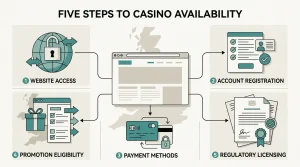


A no-KYC label may defer identity checks until a withdrawal is requested, while payment methods and limits can affect how a cashout proceeds.
What “No KYC” Means When a Withdrawal Is Due
“No KYC” can describe when checks happen, rather than a promise that they will never happen. A casino may let an account be opened and used before asking for identity documents. That does not establish that a withdrawal will be released without them.
For offshore casinos, identity checks commonly become a condition of the first cashout. The account can therefore appear to operate without verification until money is requested. At that point, the operator may ask for documents and pause the withdrawal while it reviews them. The difference is timing: checks that were not required at registration can still be required before funds are approved for release.
This distinction matters when assessing claims such as “no ID verification withdrawal casino UK”. The phrase can suggest that a player will be able to withdraw without proving identity. In practice, a no-KYC label may refer only to a lighter sign-up process or to checks being deferred. The label itself does not settle what will happen when a withdrawal is requested.
A stated payout speed does not confirm that a casino will waive identity checks: verification requirements can depend on the operator and circumstances. Use this list as a reference for the payout-speed information available, and check each operator’s terms for its withdrawal verification policy.
1. EvoSpin
Payout speed: 1-3 business days EvoSpin has a stated payout speed of 1–3 business days. This information alone does not establish whether identity verification is required for withdrawals.
2. SpinFormula
Payout speed: 1-3 business days SpinFormula has a stated payout speed of 1–3 business days. This information alone does not establish whether identity verification is required for withdrawals.
3. Zombillion
Payout speed: 1-3 business days Zombillion has a stated payout speed of 1–3 business days. This information alone does not establish whether identity verification is required for withdrawals.
4. BeOnBet
Payout speed: 1-3 business days BeOnBet has a stated payout speed of 1–3 business days. This information alone does not establish whether identity verification is required for withdrawals.
5. Jetsetspins
Payout speed: 1-3 business days Jetsetspins has a stated payout speed of 1–3 business days. This information alone does not establish whether identity verification is required for withdrawals.
6. Revery Play
Payout speed: 1-3 business days Revery Play has a stated payout speed of 1–3 business days. This information alone does not establish whether identity verification is required for withdrawals.
7. NightWin
Payout speed: 1-3 business days NightWin has a stated payout speed of 1–3 business days. This information alone does not establish whether identity verification is required for withdrawals.
8. Chanze
Payout speed: 1-3 business days Chanze has a stated payout speed of 1–3 business days. This information alone does not establish whether identity verification is required for withdrawals.
9. SlotoSport
Payout speed: 1-3 business days SlotoSport has a stated payout speed of 1–3 business days. This information alone does not establish whether identity verification is required for withdrawals.
10. Amunbet
Payout speed: 1-3 business days Amunbet has a stated payout speed of 1–3 business days. This information alone does not establish whether identity verification is required for withdrawals.
Non-GamStop casinos illustrate the gap between marketing and the cashout condition. Despite the no-KYC description used by some sites, identity documents remain part of the withdrawal approval process at most of them. “No verification” at account opening and “no verification before payment” are different claims; the first does not prove the second.
A useful way to read the wording is to separate three stages: registration, play and withdrawal. A site that does not request documents at registration has made a claim about registration. If it permits play before requesting them, that concerns access to play. Neither statement, by itself, confirms that a withdrawal can be completed without checks. The decisive condition is what the operator requires before authorising payment.
The same point applies to searches for a no-ID-verification casino or a casino with no identity checks. These phrases can describe a hoped-for outcome, but they are not evidence of the operator’s actual cashout terms. A claim about signup should not be treated as a claim about withdrawal, and a claim about a quick or simple account process should not be treated as a waiver of identity checks.
For a no-verification withdrawal casino, the relevant distinction is not whether documents were requested on the first visit. It is whether the terms allow the operator to ask for identity evidence before releasing winnings, and whether that requirement is applied when a withdrawal is made. If the operator reserves that right, a delayed check remains a check. A payment request can expose a condition that was not visible during registration.
No-Minimum-Deposit Casinos in the UK: Payment Rules
There is also a practical difference between depositing or playing and having a withdrawal approved. An account balance on screen is not the same as money released to the player. If identity documents are required at cashout, the balance may remain unavailable until the operator completes its review. This is why “no ID verification casino” is too broad to rely on without reading the withdrawal conditions: it can describe the front end while leaving the point of greatest financial consequence unresolved.
The contrast with UKGC-licensed sites is often about the checkpoint rather than the existence of checks. UKGC casinos almost always verify customers at some stage, while offshore operators may postpone the request until a first withdrawal. That timing difference can make an offshore account feel less restrictive at first, but it does not turn deferred verification into verification-free cashout.
The wording to look for is therefore not simply whether a site advertises no KYC. The relevant question is whether identity verification can be required before the first withdrawal is processed. Where that condition applies, the accurate description is delayed verification, not a guaranteed no-ID withdrawal. A claim of “no verification” only has financial meaning if it covers the withdrawal stage as well as account opening—and the label alone does not establish that.
UK-Licensed Sites and Offshore Sites: Different Checkpoints
The main difference is often when identity checks take place, not whether they exist. A UK-licensed casino may ask for information and documents while an account is being opened, before the first deposit or before gambling begins. An offshore casino may allow registration and play first, then request documents when a withdrawal is made. That later checkpoint can make an account appear to involve no verification—until funds are due to leave it.
Checkpoints
UK-licensed casinos typically verify customers during onboarding or before the first deposit, whereas offshore casinos may delay these checks until a withdrawal is requested.
For a UK-licensed operator, identity and age checks are part of the process before gambling can begin. Full customer checks are often completed before the first deposit. This means a casino with no ID verification may be difficult to reconcile with the ordinary onboarding process at a UKGC-licensed site. A site can make account creation seem simple, but that is not evidence that the operator has waived the checks required for a customer to gamble.
The practical consequence is that verification may be visible earlier on a UK-licensed site. Details supplied during registration can be checked against independent sources; further information may be requested if the initial checks do not settle the matter. A smooth signup does not establish that no checks occurred, and a request for documents later does not by itself show that a site is operating outside its stated process.
Offshore sites may arrange the checkpoints differently. Some permit account use before collecting the full set of identity documents, then ask for them when the first cashout is requested. This timing can be presented in advertising as an online casino with no verification withdrawal, but the wording can conceal a material condition: payment may depend on passing checks at that later stage. The account’s ability to accept a deposit or display a balance is not the same as confirmation that funds can be withdrawn without review.
Casinos Not on GamStop in the UK: Rules and Risks
That distinction matters when comparing a casino with no ID verification UK claims against the operator’s actual status. An early-stage account that asks for few details does not prove that identity checks have been removed. It may mean only that the operator has deferred them. The same applies to live casino no verification claims: the game format does not, by itself, determine when customer checks occur. The relevant issue is the operator’s licensing position and the conditions attached to access and payment.
The UK licensing context sets an important boundary. Remote gambling operators offering services into the British market are required to hold the relevant UK Gambling Commission licence, wherever the business is based. A foreign location or overseas licence does not replace that requirement for an operator targeting British customers. A site’s own description of its licence should therefore be distinguished from whether it holds permission to serve the British market.
Casinos & Safety: UK Licensing and Player Checks
There is a separate point about access. UK residents can legally play at casinos licensed outside the UK where the operator is not illegally targeting the UK market. That does not turn an offshore licence into a UKGC licence, nor does it place the operator inside the UK regulatory system. The fact that a site can be reached from Britain is not proof that it is authorised to offer gambling to the British market. Accessibility and regulatory status are different questions.
This difference also explains why “offshore” should not be treated as a synonym for “no checks”. Offshore casinos commonly place verification later in the customer journey, and some may rely on automated checks before requesting documents. A site can therefore conduct screening without asking for a full document package at initial registration. Conversely, a request for identity evidence at withdrawal should not be surprising merely because the site advertised a no-KYC or no-ID experience.
For an online casino no verification withdrawal claim, the useful test is not whether registration feels document-free. It is whether the terms describe a later identity checkpoint and what must be completed before a payment can be approved. The wording should be read alongside the operator’s licensing information. “No checks at signup” and “no checks before withdrawal” are not equivalent statements; the first can describe delayed verification, while the second is a much broader claim.
Do
- Assess the operator’s regulatory position separately from commercial descriptions
- Check the actual cashout terms for identity requirements
Don’t
- Assume a low-friction sign-up means identity checks are waived
- Treat “no ID verification” labels as a guarantee of document-free withdrawals
The label “best no ID verification withdrawal casino UK” cannot establish that a site will release funds without checking identity. Nor does a low-friction account opening settle whether the operator is licensed to serve British customers. The commercial description and the regulatory position need to be assessed separately: one concerns the timing of checks, the other concerns permission to operate in the market.
In short, UK-licensed and offshore casinos may place verification at different points, but a later checkpoint is not an exemption. UKGC-licensed sites commonly address KYC early, while offshore operators may leave fuller checks until a first cashout. The distinction is one of timing and regulatory status—not a reliable promise that a casino with no ID verification will remain document-free when a withdrawal is requested.
Instant Withdrawals Still Have an Approval Stage
An “instant withdrawal” is not necessarily an instant transfer from a casino balance to a bank account or payment wallet. The elapsed time has two separate parts: the casino’s approval of the request and the settlement of the payment after approval. A claim about speed is incomplete unless it is clear which part it describes.
The first stage belongs to the casino. A withdrawal request can be pending while the operator reviews the account and decides whether to authorise it. Only after approval can the payment move to the settlement stage. The second stage depends on the payment route and the organisations involved in completing the transfer. A casino may therefore approve a request promptly while the funds take longer to appear, or the request may remain unapproved before settlement has even begun.
Online Casino No Registration UK: What It Means
This distinction matters when comparing no verification instant withdrawal casinos. “Instant” may describe the operator’s handling of an approved request, rather than the time from clicking withdraw to receiving usable funds. It may also refer to the payment stage alone. Without a clear definition, the label does not establish the total waiting time or show whether the account has cleared the casino’s approval process.
The word “pending” is similarly easy to misread. It identifies an unfinished withdrawal, but not necessarily the reason it has not completed. The request could still be awaiting the casino’s decision, or approval could have been given while the payment is being settled. Those are different points in the process, even if the account display groups them under one status. A status label is not a substitute for knowing which stage is outstanding.
Identity checks can sit within the approval stage. Offshore casinos may use electronic verification, or eKYC, to run checks automatically, including where full KYC was not required at sign-up. Automation can change how a check is carried out; it does not make approval unnecessary. A no ID verification online casino claim therefore cannot establish that a withdrawal will bypass review. The operator still controls whether the request is approved, and an automated check may form part of that decision.
The same distinction applies to searches for no verification withdrawal casino sites. A site can present its payment service as fast while retaining an approval step before funds are released. The advertised speed and the account-checking process answer different questions: one concerns movement of money, the other concerns permission to send it. Treating them as a single promise makes it difficult to tell what “instant” is supposed to measure.
Understanding “Instant” Withdrawals
An instant withdrawal consists of two separate stages: the casino’s approval of the request and the subsequent settlement of the payment. A speed claim may only refer to the settlement stage, while the approval process can still be delayed by identity checks.
A useful comparison separates the stated stages rather than relying on a single headline. The relevant details are whether the advertised timing begins when the withdrawal is submitted or only after it is approved, whether the casino describes its own review separately from payment settlement, and what status the account shows when a request is incomplete. If the terms do not explain these points, the claim provides little basis for estimating when funds will arrive.
This is not a technicality in the wording. A payment cannot be treated as completed merely because the casino has accepted the request, and a fast settlement route cannot resolve a request still awaiting approval. Conversely, a delay after approval does not by itself show that the casino has not authorised the withdrawal. The stages need to be read independently.
For no ID verification withdrawal casino sites UK, the central issue is therefore not whether the word “instant” appears, but what event starts the clock. If the clock starts only after approval, it excludes the casino’s review from the advertised timing. If it begins at submission, the wording still does not explain whether verification could interrupt the process. A reliable description would make the starting point and the approval stage explicit; otherwise, “instant” is a narrow label, not a complete payout timetable.
The difference between the two stages also explains why payment speed alone cannot settle expectations. The payment route operates only once the casino has authorised the request. Until that point, the account remains within the operator’s process, whatever speed is associated with the method selected. Once approval is complete, settlement is a separate step, not proof that the earlier review was absent.
VPN-Friendly Casinos in the UK: Rules and Risks
An instant label can be accurate for one stage and still give an incomplete picture of the withdrawal as a whole. Approval and settlement have to be considered together, because the total wait includes both. Without a stated start point and a clear account of the approval step, a headline speed cannot tell whether it describes the entire journey or only the final movement of funds.
Fast Payouts Meet Withdrawal Limits
A quick payment route does not determine how much can leave a casino account within a given period. Withdrawal limits set a separate ceiling: daily, weekly or monthly caps can divide a large balance into several permitted cashouts. The transfer may move quickly once released, while access to the full amount remains spread over time.
A specialist review reports that many offshore casinos set daily, weekly or monthly withdrawal limits, with larger wins potentially taking longer to cash out as a result. The same type of review describes monthly caps at offshore casinos as a possible reason for delayed access to a substantial win. These are reported conditions, not a single rule applying to every operator; the relevant terms depend on the casino.
The arithmetic is straightforward. If a balance exceeds the applicable cap, the amount above it cannot be withdrawn in the same period. It remains subject to the casino’s limit until a later withdrawal period, so a fast-withdrawal claim may concern the speed of each permitted payment rather than the time needed to receive the whole balance. The word “fast” does not remove that distinction.
Withdrawal Limits
Fast payout claims do not remove withdrawal ceilings; daily, weekly, or monthly caps may require large wins to be cashed out over several separate transactions.
The cap also needs to be read alongside the period it covers. A daily limit and a monthly limit constrain withdrawals on different schedules; one cannot be treated as a substitute for the other. Where an operator publishes more than one limit, the practical restriction may depend on how those limits apply together. The terms should state the relevant cap and period clearly enough to calculate the withdrawal schedule before play.
This matters particularly when a casino is promoted as offering fast cashouts or no ID verification. Those labels do not establish that the full balance can be paid at once, nor do they change a withdrawal ceiling. A low-friction route can still have a slow overall outcome if repeated capped withdrawals are required. The useful comparison is therefore not simply how quickly one payment is processed, but whether the stated limits allow the balance to be accessed on a workable schedule.
A large win and a small permitted withdrawal are not equivalent to immediate access to the win. Before treating a fast payout as a meaningful feature, the casino’s terms need to be checked for the amount allowed per period and whether separate daily, weekly or monthly caps apply. If the limit is not clear, the payout claim alone gives no reliable basis for estimating when the whole balance would be available.
Real-Money Play Still Requires Account Checks
A successful deposit confirms that a payment method has been accepted; it does not establish that an account is cleared for every later transaction. The same distinction applies to real-money play: being able to open games or place bets is not proof that the operator has completed all checks relevant to the account.
Non-Gamban Casinos UK: Access and Self-Exclusion
For customers in Great Britain, the regulatory requirement is earlier and explicit. Online gambling businesses must verify a customer’s age and identity before allowing them to gamble. A claim of no ID verification for a real-money casino therefore should not be read as permission to play anonymously at a UK-licensed site.
The scope of a check can also extend beyond identity documents. A specialist review of no-KYC casinos reports that an operator may ask for evidence of address, contact details or the source of funds, alongside identity verification. That is a report about possible requirements, not a universal checklist for every casino. The practical point is that “no ID” advertising does not settle what information an operator may request when reviewing an account.
These categories answer different questions. Identity documents establish who holds the account; address evidence relates to where that person lives; contact details help connect the account to its holder; source-of-funds checks concern the origin of money used. A request in one category does not mean the others have automatically been satisfied.
That matters when assessing an online casino described as offering real money with no verification. A deposit going through, or a game accepting a stake, is not a reliable test of whether the account will pass later review. Nor does the word “anonymous” establish that no personal information will be requested. The operator’s terms and verification policy determine what can be required, while the account’s status determines whether requested information has been accepted.
The financial calculation is simple: a playable balance is not the same as an unrestricted balance. Any account terms that reserve the right to request further information leave that possibility in the transaction chain. “No ID verification” may describe a limited point in registration or play; it should not be treated as a promise that real-money activity can remain anonymous throughout.
Verification Scope
Beyond identity documents, operators may request proof of address, contact details, or evidence regarding the source of funds during account reviews.
The Cost of Offshore Payments
A payment route has two separate costs: the fee charged for moving money and the chance that the transaction will not go through as planned. Offshore casinos can offer methods unavailable at UK-licensed sites, but access is not the same as a cost-free or dependable transfer.
Credit cards show the difference clearly. Credit card gambling has been prohibited at UK-licensed operators since April 2020, while offshore casinos may accept Visa and Mastercard. A specialist review reports deposit charges of 2% to 5% at offshore casinos. That is a reported range, not a universal tariff: the actual charge depends on the payment arrangement and should be checked before a deposit is made. A percentage fee also grows with the deposit, reducing the amount that reaches the casino balance.
The cost can recur on the way out. A specialist review gives a range of £10 to £50 for bank-transfer withdrawals at offshore casinos. The fee may be fixed rather than proportional, so its effect depends on the size of the withdrawal: a fixed charge takes a larger share of a smaller payment. Deposit and withdrawal costs should therefore be assessed together, not as isolated entries in a cashier menu.
Bank handling adds a less predictable cost: delay or failure. British banks may decline, flag or delay payments to offshore gambling operators, and some may block them. One specialist review reports that certain UK banks block offshore gambling transactions by default. That is a source-specific report, not a rule applying to every bank. A declined payment can interrupt a deposit; a delayed or blocked transaction can leave funds unavailable while the bank or payment provider reviews it. The advertised payment method does not control that decision.
The UK Gambling Commission can also block payment transactions to unlicensed operators. This means that an offshore casino’s acceptance of a card does not establish that the payment will be approved by the bank or remain free of regulatory intervention. The operator, the payment processor and the bank each sit at a different point in the transaction chain. A failure at any one point can make a nominally available route unusable.
Non-UK casinos: regulation, licences and protections
For a real-money account promoted as offering little or no verification, “anonymous” should not be read as financially invisible. A card or bank payment still passes through financial institutions, where it may be identified, questioned or stopped. Avoiding a document check at registration does not remove the bank’s own controls, nor does it guarantee that a later transfer will be treated as routine.
The practical comparison is therefore between the full cost and the uncertainty attached to each route. A card deposit may carry a fee; a bank transfer may incur a withdrawal charge; either can face bank friction. The relevant figure is the net amount received after charges, alongside the possibility that the payment is delayed or refused. A low-friction label on a casino cashier is not a price quote from the bank.
Mobile Payments Are a Deposit Route, Not a Cashout Route
Paying through a phone bill can look like a way to keep a casino transaction within a mobile account. At offshore platforms, however, Boku and similar services are described in specialist reviews as deposit methods, not withdrawal channels. The distinction matters: a payment option shown at the cashier may fund play without offering any route for returning a balance.
Deposit Only
Mobile billing services like Boku are typically deposit methods only; they do not provide a route for withdrawing funds or bypassing identity checks.
That makes mobile billing a poor fit for anyone comparing casinos on cashout access. Deposits and withdrawals are separate functions, and a method available for one does not imply availability for the other. A phone-bill payment therefore cannot be treated as a way to receive winnings or bypass the casino’s withdrawal process.
The “no verification” label does not change that limitation. Mobile billing concerns how money enters an account; it does not establish that identity checks are waived, nor does it create a withdrawal route. The method answers one narrow question—whether a deposit can be charged through a mobile payment service—and leaves cashing out to the casino’s other supported methods.
Before depositing, the cashier’s withdrawal options should be assessed independently from its deposit list. If mobile billing is the only acceptable way to fund an account, that preference does not solve the separate problem of how any remaining balance could be paid out. A deposit route is not a cashout route.
Bitcoin Withdrawals: Speed Does Not Remove Verification
Bitcoin can shorten the payment leg of a casino withdrawal, but it does not settle the separate question of whether the casino will approve the request. A claim of a Bitcoin casino with no ID verification should therefore be read as a claim about the account process, not as evidence that a cashout will be released without checks.
Published timings vary. Specialist reviews report that cryptocurrency withdrawals at some offshore operators may take one to six hours, while other descriptions put processing in minutes. These are reported expectations, not a dependable payout deadline for every Bitcoin casino. The operator’s own approval process and the terms attached to the account still matter; a quick payment route cannot make a pending withdrawal payable.
Non-GamStop European Casinos: UK Rules Explained
Nor does using Bitcoin establish an exemption from identity checks. Offshore casinos typically ask for identity documents before processing a first withdrawal, even where verification was not completed at registration. A request for documents can therefore interrupt a payout advertised as fast. The same practical limit applies to searches for a Bitcoin casino with no ID verification in the UK: the label does not guarantee that a player can withdraw without proving identity.
The useful comparison is between the advertised timing and the condition for release. A stated processing time describes what may happen after the casino accepts the withdrawal; it does not promise that approval is immediate or that verification will not be requested. A Bitcoin balance visible in an account is not the same as funds already released.
For a realistic assessment, the withdrawal terms need to be read alongside any verification wording, including what may be requested before a first cashout. If those terms reserve the right to check an account, the “no verification” label does not remove that condition. Bitcoin changes the payment method, not the operator’s ability to require identity documents before paying.
Crypto Casinos and the Limits of “No KYC” Claims
Accepting cryptocurrency does not, by itself, make a casino anonymous or remove identity checks. The payment method and the operator’s verification policy are separate parts of the account: Bitcoin or another crypto asset may be accepted while identity checks remain a condition of using the service.
eKYC
Electronic identity verification that allows operators to run customer checks automatically, often making the verification process less visible than manual document requests.
Some offshore casinos use electronic identity verification, or eKYC, to run checks automatically. A registration process that does not ask for a full set of documents at the outset therefore does not establish that the account will never be checked. Automated checks may also be less visible than a manual request for paperwork, which can make a “no KYC” label sound broader than the actual terms.
For a crypto casino, the relevant distinction is often when verification happens, not whether it exists. Offshore operators may delay full checks until a withdrawal is requested; identity verification can still be required before funds are released. That is delayed KYC, not a no-verification arrangement. A withdrawal condition remains a condition even if it appears only after deposits and play.
The same distinction applies to claims about a no-verification crypto casino in the UK. Cryptocurrency does not create an exemption from checks, and a site’s payment options cannot establish what its account rules require. The terms should be read for verification triggers and document requirements, rather than inferred from the absence of an identity prompt at sign-up.
“Anonymous” is consequently a weak description of an account whose operator may apply eKYC or request checks before withdrawal. The practical measure is not whether crypto can be deposited, but whether the operator’s stated verification conditions allow the account to be used and winnings to be withdrawn without documents. If checks are a possible withdrawal condition, the “no KYC” claim has a clear limit.
Bonuses, GamStop and the Conditions Behind the Claim
A no-deposit bonus is an advertising offer, not evidence that a casino waives identity checks, holds a UK licence or participates in a UK self-exclusion scheme. The phrase “no verification” describes a claim about account checks; it does not establish what happens when a withdrawal is requested. Nor does a bonus label establish that funds can be withdrawn without conditions.
The same distinction applies to offers described as no-ID bonuses. A casino’s promotion and its regulatory status are separate matters. Before treating an offer as relevant, its terms need to be read alongside the operator’s licence details and the rules governing withdrawal. The word “free” does not settle the final amount available to cash out.
Online Casinos with No Sister Sites in the UK
What GamStop membership establishes
UK-licensed operators must integrate with GamStop. A customer who has self-excluded through the scheme is therefore not meant to use a UK-licensed casino covered by that exclusion. A bonus promotion does not change that obligation.
Non-GamStop casinos are not connected to the national self-exclusion database because they do not hold a UK Gambling Commission licence. They operate under overseas licences, and those operators are not required to integrate with GamStop. That is a difference in coverage, not evidence that the sites are safer, that their bonus terms are more favourable or that self-exclusion can be bypassed without consequence. It should not be treated as a route around an existing exclusion.
The phrase “non-GamStop” describes the scheme connection, not a guarantee about verification or a special category of bonus. A site may advertise a no-deposit offer while remaining outside GamStop; neither fact alters the other. Someone relying on GamStop should not treat an offshore promotion as compatible with that protection.
Check the licence separately from the offer
For a UK-facing casino, the relevant question is whether the operator holds a current UK Gambling Commission licence. Remote operators selling into the British market are required to hold the relevant licence, regardless of where they are based. An overseas licence is not a UKGC licence, and a bonus banner does not make it one.
The licence number should be checked against the issuing regulator’s public register before depositing. That check answers a different question from reading the promotion: the register concerns the operator’s authorisation, while the offer terms set out the offer’s conditions. Neither should be inferred from the other.
Searches for a no-verification casino no-deposit bonus combine several claims that need separate assessment: whether an offer exists, what its conditions are, what checks apply, and which self-exclusion scheme covers the operator. Without confirmed terms, no particular bonus value, eligibility rule or withdrawal condition can be assumed. The financially sound comparison starts with what is documented, not with the word “free”.
Can non-UK-registered casinos refuse to pay out my winnings?
They may hold a withdrawal while requiring identity documents and completing their checks. Having a balance in your account does not mean the money has been approved for release.
How long does it take to get the money?
It depends on the withdrawal method and the casino’s approval process. Cryptocurrency withdrawals can take minutes to six hours, while Skrill and Neteller withdrawals at established offshore casinos typically clear within 24 hours; withdrawal limits can also delay larger wins.
Do UK banks block deposits to non-GamStop casinos?
Yes, some UK banks may decline, flag, delay or block payments to offshore gambling sites. The UK Gambling Commission can also block payment transactions to unlicensed operators.
Material created by the team Jettbet