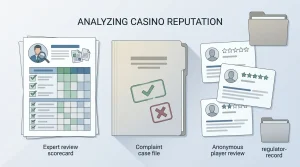


Understand how UK gambling law treats offshore operators and what licensing, payments, promotions and safeguards can—and cannot—establish.
What “Offshore” Means Under UK Gambling Law
In the British gambling market, “offshore” describes an operator’s position relative to UK regulation; it does not simply mean that a company is based abroad. An offshore casino is an online gambling operator that accepts customers in Britain without holding a licence from the UK Gambling Commission (UKGC). The defining point is the absence of a UKGC licence, not the operator’s address or the name it gives its service.
That distinction matters because a business can be incorporated overseas and still need UK authorisation if it offers gambling to customers in the regulated British market. Conversely, describing a site as foreign does not establish that it is outside the UKGC’s requirements. The relevant question is whether the operator provides gambling facilities to customers in England, Scotland or Wales.
The Gambling Act 2005 governs gambling in England, Scotland and Wales. Under that framework, remote operators selling gambling services into those markets must hold the relevant UKGC licence, regardless of where they are located. The licensing requirement therefore follows the service and the customers it serves, rather than stopping at the operator’s national border. A site does not avoid the requirement simply because its company or servers are based elsewhere.
Choosing an offshore casino site means weighing what is known about the operator before deciding whether it suits you. Use this list as a starting point, and check the details that matter to you before signing up.
1. EvoSpin
Payout speed: 1-3 business days EvoSpin lists a payout speed of 1–3 business days.
2. SpinFormula
Payout speed: 1-3 business days SpinFormula lists a payout speed of 1–3 business days.
3. Zombillion
Payout speed: 1-3 business days Zombillion lists a payout speed of 1–3 business days.
4. BeOnBet
Payout speed: 1-3 business days BeOnBet lists a payout speed of 1–3 business days.
5. Jetsetspins
Payout speed: 1-3 business days Jetsetspins lists a payout speed of 1–3 business days.
6. Revery Play
Payout speed: 1-3 business days Revery Play lists a payout speed of 1–3 business days.
7. NightWin
Payout speed: 1-3 business days NightWin lists a payout speed of 1–3 business days.
8. Chanze
Payout speed: 1-3 business days Chanze lists a payout speed of 1–3 business days.
9. SlotoSport
Payout speed: 1-3 business days SlotoSport lists a payout speed of 1–3 business days.
10. Amunbet
Payout speed: 1-3 business days Amunbet lists a payout speed of 1–3 business days.
For this purpose, the law treats a casino as an arrangement that gives people the opportunity to take part in one or more casino games. The online format does not change the central question: whether an operator is providing gambling facilities to customers in a place where a UKGC licence is required. A website presented as an offshore online casino may fall within that description if it accepts British customers, even though its business is based outside the country.
The legal distinction is between the operator’s conduct and the player’s conduct. An operator without a Gambling Commission licence acts unlawfully if it offers gambling services in England, Scotland or Wales. It is also unlawful for that operator to advertise its services in the UK. Those restrictions concern the business supplying or promoting the gambling, not the mere fact that a British resident places a bet with an overseas operator.
Playing at a casino licensed outside the UK is not, by itself, illegal for a British player. UK law does not prohibit an individual from placing bets with an overseas operator, and the player does not incur a criminal penalty simply for doing so. That does not make the operator’s activity lawful: the absence of a player offence and the operator’s licensing obligation are separate legal questions.
This separation is easy to blur in casual descriptions of offshore casinos in the UK. Calling a site “illegal” without specifying whose conduct is at issue can suggest that the customer commits the same offence as the operator. The legal position is more precise. An operator offering gambling facilities to customers in England, Scotland or Wales must hold a UKGC licence; an individual placing a bet with an overseas operator is not criminally liable merely for placing that bet.
Nor does the word “licensed” resolve the UK question on its own. An operator may hold permission from a regulator outside Britain, but that fact does not answer whether it has the UKGC authorisation required to offer services to customers in the British market. For the legal definition of an offshore casino, the operative distinction is whether the UKGC licence is held while British customers are accepted.
The terms “UK offshore casinos” or “offshore casino sites in the UK” can therefore refer to a category defined by the relationship between an operator and the British market, rather than a particular corporate location. A company’s overseas base is not enough to classify its service. The service must be considered in relation to the customers it accepts and the UK licensing requirement that applies to operators serving them.
The relevant scope is Great Britain: England, Scotland and Wales. The Gambling Act 2005 does not govern Northern Ireland, so the same description should not be extended to that jurisdiction as though the legal framework were identical. Within Great Britain, the basic boundary remains consistent: the operator must hold a Gambling Commission licence to provide online gambling facilities to customers there. An overseas operator’s location does not remove that obligation, while a player’s decision to place a bet does not create the corresponding operator offence for the player.
An operator offering gambling services in England, Scotland or Wales without a UKGC licence acts unlawfully, though a British player placing a bet with such an operator is not personally criminally liable.
What a Site’s Licence Does—and Does Not—Establish
An offshore licence identifies a regulator outside the UK as the authority under which an operator says it is licensed. It is relevant information about the operator, but it is not a UK Gambling Commission licence, a UKGC endorsement or permission to offer gambling to customers in Britain. Those are separate regulatory positions; an authorisation issued elsewhere cannot stand in for the UK licence required to serve the British market.
That distinction matters when comparing offshore online casinos. A licence label can tell a reader which jurisdiction an operator relies on. It cannot, by itself, establish that the operator is regulated by the UKGC or that its licence covers activity in the United Kingdom. Treating “licensed” as a complete answer obscures the question that matters in this market: licensed by whom, and for what territory?
The Santeda case makes the boundary concrete. Santeda holds a Curaçao licence, but that authorisation does not give the company permission to operate in either the UK or the US. The issuing jurisdiction and the permitted markets are not interchangeable. A licence from one authority does not automatically travel with the operator into every country where its website can be viewed.
Non-GAMSTOP Curaçao Casino Sites: UK Rules Explained
This is why “licensed offshore” and “UK-regulated” should not be used as if they were two descriptions of the same status. The first refers to an authorisation outside the British system; the second means that the operator holds the relevant UKGC licence. An offshore casino may state its licensing position accurately and still not be regulated by the UK Gambling Commission. Both statements can be true at once.
The label also needs to be read narrowly. It records a regulatory claim about the operator’s status under an offshore authority. It does not establish UKGC oversight, and it does not prove that the operator is authorised to serve British customers. Nor does the word “licensed”, without the regulator and territory attached, tell the full story. A useful description names the authority rather than leaving the word to carry more weight than it can support.
For online offshore casinos, the regulator’s identity is therefore more informative than the adjective alone. The same general principle applies whether a site calls itself an offshore casino, an international casino or a non-GamStop casino: those terms do not identify a UKGC licence. They describe a relationship to markets or schemes, not a replacement for British regulation. A foreign licence remains foreign even when the site is accessible from Britain.
A licence should not be mistaken for a universal certificate. It does not convert a site into a UK-licensed casino, and it does not establish that the UKGC supervises the operator. In practical terms, the licence answers a limited question about the operator’s stated regulatory basis. It does not answer every question about the site, and it cannot be used as shorthand for permission to operate in the UK.
This is also why a list of the best offshore online casinos cannot be assessed by the licence word alone. A listing may display a regulator’s name, but that detail does not change the operator’s UKGC status. The relevant distinction is not whether some licence exists somewhere; it is whether the licence is the one required for the market in which the service is being offered. For a British-facing site, offshore authorisation and UKGC regulation remain separate categories.
The same reading applies to a page that advertises a licence prominently. Placement and wording do not expand its scope. If the authority is offshore, the site is not thereby brought within UKGC regulation. That is the boundary the label cannot cross: an offshore authorisation may describe the operator’s position under another regulator, but it does not confer British permission or British regulatory status.
For a reader evaluating an offshore casino online, the licence is therefore a piece of identification, not a substitute for distinguishing jurisdictions. It can show which regulator the operator invokes; it cannot make that regulator the UK Gambling Commission. The label has meaning, but only within its stated limits.
Why an Offshore Casino Listing Is Not a Safety Check
A listing can show that a site is visible, accepting registrations or being discussed. None of those facts establishes that a customer can recover funds if a withdrawal is disputed. A directory entry is a point of discovery, not a guarantee of access rights, payment or independent dispute resolution.
That distinction matters because access from Britain is not proof that an operator is permitted to serve the British market. Remote gambling operators serving customers in Great Britain are required to hold a UK Gambling Commission licence. Offshore casinos are outside that regulator’s system, and their presence on a list does not change that position. They are not subject to UKGC enforcement or the Commission’s player-protection requirements, including mandatory affordability checks.
Access itself can also be a weak signal. Gambling.com has reported that some casinos licensed outside the UK are meant to prevent access by British visitors, while some do not enforce that restriction; it also reports that a basic VPN can be used to bypass a block. This is a report about access practices, not a dependable rule for every site. A page loading from Britain, or a registration form accepting details, therefore says little about what happens if the operator later disputes a customer’s location or eligibility.
The same caution applies to claims that a site is a legitimate offshore casino. The phrase does not identify who has checked it, what was checked or whether the assessment covers a specific customer’s withdrawal. A list may describe a licence, but the label alone cannot establish how a complaint would be handled or what remedy would be available. Those are separate questions from whether the site appears online.
The practical test comes when a balance is due. Gambling.com has reported cases in which unlicensed sites refused to release winnings, leaving customers without legal recourse. That does not mean every offshore casino will withhold a payout. It does mean that a listing cannot remove the consequence of dealing with an operator beyond the UKGC system: if a dispute arises, the customer may have no effective route to compel payment.
Financial Risk
Using offshore casinos means operating outside the UKGC system, which may leave customers without legal recourse or a way to compel payment if a dispute arises over winnings.
A published review or directory can also become outdated as a site changes its access rules or operating arrangements. A listing should not be treated as a live confirmation that a site remains accessible, accepts British customers, or will honour a particular withdrawal. The operator’s own terms may set conditions, but terms are not the same as an independent mechanism for enforcing them.
This is why an offshore casino list cannot function as a safety check. It may help identify sites, but identification is not verification of UK authorisation, and visibility is not evidence of reliable recourse. Even a site described as licensed offshore is not thereby regulated by the UK Gambling Commission. The licence label and the customer’s position in a payout dispute are different matters.
For a British customer, the central exposure is not simply that a site might be difficult to access. It is that money can be deposited while the route to resolving a later disagreement remains uncertain. A list can record a name; it cannot guarantee the operator’s decision, provide UKGC oversight or supply legal recourse where none is available.
When Commercial Ties Matter More Than the Licence Label
A licence label describes a regulatory relationship; it does not, by itself, show how a gambling business earns revenue or which commercial partners share in it. Those are separate questions. A documented contract involving Santeda and sports data company SIS illustrates why the distinction matters: SIS received a percentage of revenue from losing bets placed through Santeda’s brands.
The wording of that arrangement matters. The revenue share was linked to losses, not simply to the volume of bets placed. That gives SIS a financial connection to the outcome of customers’ betting activity. It is a specific commercial incentive, and it cannot be understood from a casino’s licence label alone.
That connection is relevant context, but it does not establish that SIS controlled the casino, influenced individual results, or took part in decisions about customers’ accounts. Nor does it prove that any bet was unfairly settled. Those would be different claims, requiring evidence beyond the existence of a revenue-sharing contract. The documented point is narrower: a third-party sports data company received a share of revenue generated by losing bets at brands operated by Santeda.
For a reader assessing offshore casinos, this kind of relationship belongs in a different column from licensing. The licence concerns the operator’s regulatory status. A revenue-sharing agreement concerns the flow of money between businesses and the basis on which a partner is paid. Treating one as a substitute for the other would leave a material part of the commercial arrangement unexamined.
The relevant question is not whether a partnership sounds reputable. A sports data company may provide services to a gambling business, but the title of the supplier does not explain its payment terms. Here, the stated payment basis was losing-bet revenue. That is more informative than a generic description of a commercial partnership, while still not answering every question about the relationship.
The arrangement also should not be inflated into a claim about all offshore casino sites. The contract described is specific to Santeda’s brands and SIS. It does not establish that other operators use the same structure, or that every data supplier is paid on the same basis. The commercial detail has value precisely because it is attached to an identified relationship rather than treated as a market-wide rule.
Online Casinos with No Sister Sites in the UK
This distinction is particularly useful when a site presents familiar commercial names or partnership language as a sign of quality. A business relationship can show that two companies have a financial arrangement; it cannot, without more, certify the quality of the casino’s customer service, the fairness of its games, or the handling of a dispute. Those conclusions do not follow from the partner’s name.
Santeda’s brands are offshore and are not regulated by the UK Gambling Commission. They are also outside UKGC-mandated affordability checks. Those facts describe the regulatory setting; the SIS contract describes a separate financial relationship. Neither should be used to imply more than it establishes.
In practical terms, the documented revenue share is a reason to examine incentives carefully, not a verdict on the conduct of either company. The payment condition is clear enough to matter: losing bets generated revenue from which SIS received a percentage. Whether that relationship affected any particular decision is not established by the contract fact alone.
Payment Methods, Withdrawal Timelines and the Real Cost of Waiting
The payment method sets only part of the withdrawal timetable at casinos operating under an offshore licence. The operator’s own handling rules can add time before a payment reaches a bank, e-wallet or crypto wallet. A quoted transfer speed is therefore not the same as the time from requesting a withdrawal to receiving usable funds.
Mobile Casinos That Accept Phone Credit in the UK
A specialist review reported that Skrill and Neteller withdrawals at many foreign casinos clear within 24 hours, with some processed in under 12 hours. Those figures describe reported processing times, not a commitment applying to every casino site with an offshore licence. A pending period, verification step or operator-side queue can extend the wait. The relevant terms are the ones governing withdrawals, not merely the payment methods shown at the deposit stage.
Bank transfers were reported in a specialist review as the slowest route, often taking five to seven business days. Some operators also apply their own processing delay before the bank transfer begins. The practical total can therefore include two separate stages: the casino’s release of the funds and the bank’s handling of the transfer. A timeline that describes only the banking stage leaves out the part the operator controls.
A specialist review also reported that crypto withdrawals at foreign casinos can clear in under an hour, faster than fiat methods. That speed does not make the amount received fixed: the value of cryptocurrency can move while the withdrawal is being processed or held. The faster route therefore has a separate cost risk, measured in changing value rather than waiting time. The timing and volatility should be considered together, not treated as interchangeable advantages.
Across offshore casino withdrawal methods, limits, pending periods and verification procedures differ considerably by operator. A short stated processing time cannot establish when a request will be approved, whether documentation will be required, or how much can be withdrawn at once. These conditions affect the final timetable and can make two casinos using the same payment provider produce different outcomes.
E-wallets
Skrill and Neteller withdrawals often clear within 24 hours, with some processed in under 12 hours.
Bank Transfers
Typically the slowest route, often taking five to seven business days plus operator processing time.
Cryptocurrency
Can clear in under an hour, though the sterling value may fluctuate during processing.
That uncertainty matters because offshore casinos are not regulated by the UK Gambling Commission. They are also not subject to UKGC-mandated affordability checks. A payment page may describe a route and its expected processing window, but it does not provide the regulatory protections attached to a UKGC-licensed operator.
Comparisons are most useful when they separate the casino’s handling time from the payment provider’s transfer time and identify any pending period or verification requirement. Without that breakdown, “fast payout” describes one stage at best. The money is available only when the full process is complete.
Games and Promotions: What Can Be Established Without a Catalogue
An offshore casino’s promotional terms sit outside the UK Gambling Commission’s rules for licensed operators. A specialist review describes foreign welcome packages as larger because these operators are not bound by the Commission’s restrictions on bonus terms, wagering requirements and promotional language. That is a reported comparison, not a fixed feature of every site or offer.
The distinction concerns the terms an operator can advertise and attach to a promotion. It does not establish the value of a particular package, how readily its conditions can be met, or whether bonus funds will suit a player’s intended use. A larger headline offer is a larger advertised figure; its practical value depends on the conditions attached. Those conditions need to be read as part of the offer, not as fine print detached from it.
Promotional language also needs to be separated from evidence about the underlying service. A welcome package cannot establish that an operator is reliable, that a withdrawal will be honoured, or that a dispute will have an effective remedy. Nor does the size of an offer establish that a site is safe. These are separate questions, and the promotional figure answers none of them.
The same distinction applies to games. A welcome offer is not evidence of the breadth, quality or availability of a casino’s game selection. Claims about offshore casino games cannot be inferred from the promotional terms alone. A named game or provider would need to be supported by the operator’s actual catalogue; a bonus headline is not a catalogue.
Online Slots Not on GamStop: What to Know
For British customers, the regulatory boundary remains material. Offshore casinos are not regulated by the UK Gambling Commission, and they do not provide the UKGC-mandated affordability checks that apply within its system. A promotion offered outside those rules should therefore not be read as carrying the protections attached to a UKGC-regulated offer.
The commercial comparison is narrow: specialist review coverage reports that foreign casinos may advertise larger welcome packages because UKGC restrictions on promotional terms and language do not bind them. “May” matters. It avoids turning a reported pattern into a promise that any particular operator will offer more, or that a larger package is better after its conditions are applied.
The financial reading is straightforward. Promotional size is an input; the conditions determine what that input can become. A package can look generous in its headline presentation while leaving its actual value dependent on terms. Without examining those terms, the headline alone is not a meaningful measure of benefit.
Bonus Turnover Calculation
Step 1: Identify the Bonus
A player receives a £20 bonus or a £100 deposit match.
Step 2: Apply the Wagering Requirement
Multiply the bonus amount by the requirement (e.g., 35x).
Step 3: Determine Total Turnover
For a £20 bonus, the requirement is £700; for a £100 match, it is £3,500 in qualifying bets before cash-out.
Bonus Maths: Turnover Before Any Cash Is Withdrawable
A bonus headline is not the same as cash available to withdraw. Where wagering applies, the requirement sets a qualifying betting total that must be reached before bonus funds can become withdrawable. The useful comparison is therefore not the advertised bonus alone, but the amount of betting attached to it.
A specialist casino review illustrates the calculation with a £20 bonus carrying a 35x wagering requirement: £20 multiplied by 35 means £700 in qualifying bets before cash-out. That figure is turnover, not a loss estimate or a promise that the account will retain its balance. The bets could produce wins or losses; the requirement measures how much must be staked.
The same arithmetic applies to a deposit match. In the example described by a specialist review, a 100% match adds £100 in bonus funds and attaches a 35x requirement to that bonus. The required turnover is £100 multiplied by 35, or £3,500, before those bonus funds convert to withdrawable cash. A matching deposit does not make the bonus itself withdrawable: the turnover condition remains.
At foreign casinos serving UK players, specialist reviews identify deposit matches, free-spins packages, no-deposit bonuses and cashback offers as common formats. Their labels do not determine the cost. The relevant terms are the amount counted for wagering and the qualifying-bet rules attached to the promotion. A no-deposit offer may avoid a deposit condition, but that does not by itself establish that winnings can be withdrawn without meeting other stated terms. The promotional label is not the calculation.
A no-deposit bonus should therefore be assessed by tracing the path from credit to cash: what amount is subject to wagering, which bets count, and what condition must be satisfied before withdrawal. If a headline gives only the bonus value, it does not show the required turnover. If it gives the multiple but not the amount to which that multiple applies, the arithmetic cannot yet be completed.
The final amount that matters is the qualifying turnover, not the size of the banner. With a stated amount and multiple, multiplication makes the condition visible; without both, the offer’s cash-out threshold remains unclear.
Crypto Withdrawals: Faster Settlement, Variable Value
A specialist review of foreign casinos reports that crypto withdrawals can clear in under an hour, faster than fiat withdrawals. That is a reported timing, not a settlement guarantee: the casino’s own handling and the transfer process still matter, and timing can vary.
Speed is only one part of the calculation. Cryptocurrency can change in value while a withdrawal is being processed or held. The amount received in pounds may therefore differ from the value implied when the withdrawal was requested. A quick transfer reduces the waiting period; it does not fix the sterling value.
That distinction matters when comparing a crypto balance with a cash balance. A stated crypto amount is not the same as a fixed pound amount. If the asset falls in value before conversion, the eventual sterling proceeds may be lower; if it rises, they may be higher. The direction cannot be assumed in advance. A fast settlement can narrow the period of exposure, but it cannot remove price movement.
The operator’s terms also determine how a withdrawal is handled, including any processing steps before funds are sent. A claim of rapid crypto payment should therefore be read as a possible processing outcome, not as a promise that every withdrawal will arrive within the same time. The value risk remains separate from the timing claim.
Non-UK Registered Casinos: Licensing and Player Risks
There is also a regulatory distinction. Offshore crypto casinos are not regulated by the UK Gambling Commission, and they do not provide UKGC-mandated affordability checks. A cryptocurrency payment method does not change that position or make a foreign operator subject to UKGC oversight.
The practical comparison is between settlement speed and value certainty. Crypto may deliver funds sooner, according to the specialist review, but the pound value can move during the process. A withdrawal decision based only on the time quoted leaves that second variable out of the calculation.
KYC Claims, GamStop and Safeguards Outside UKGC Oversight
A “no-KYC” label is not evidence that an account can be used without checks. Age must be verified before a gambling operator allows deposits, and identity procedures can differ between offshore casinos. A specialist review reports that verification requirements, withdrawal limits and pending periods vary by operator. That variation matters: a claim about quick registration does not establish what documents may be requested later, including when a withdrawal is being processed.
GamStop works across UKGC-licensed operators. Registering for self-exclusion blocks access to every UK-licensed gambling site covered by the scheme. Offshore casinos are outside the UKGC’s remit and are not required to participate in GamStop, so the exclusion does not extend to them.
A specialist review reports that someone who has self-excluded may be able to register with a foreign casino and deposit without the protections attached to that exclusion. The practical consequence is serious: the barrier intended to interrupt gambling does not follow the player to an operator outside the scheme. Access there should not be treated as a continuation of the self-exclusion arrangement.
Nor does the absence of a GamStop block mean that equivalent safeguards apply. Offshore casinos are not regulated by the UK Gambling Commission and do not provide UKGC-mandated affordability checks. A site’s own verification process is not a substitute for those regulatory protections. For someone relying on self-exclusion to control gambling, access to a non-GamStop casino can therefore undermine the restriction rather than solve an account-access problem.
UK-Licensed Sites as the Regulated Alternative
The difference between a UK-licensed casino and an offshore casino is primarily the regulatory position of the operator, not the tax treatment of a win. A site serving customers in Great Britain for real-money gambling must hold the relevant UK Gambling Commission licence. An offshore operator without that licence is outside UKGC regulation and does not provide the same regulatory framework.
That distinction does not make the player’s act a criminal offence. UK law does not impose a criminal penalty on a resident simply for placing bets with a foreign casino. The legal requirement falls on operators offering gambling to British customers: they need the appropriate UKGC licence. An offshore site accepting British customers therefore does not become UK-licensed merely because it can be reached from the country.
A UK-licensed site is the regulated alternative for someone who wants an operator within the UKGC system. Offshore operators do not offer UKGC-mandated affordability checks, another difference that matters when comparing the two markets. The absence of those checks is not an extra form of player protection; it is a safeguard that does not apply through the UK regulator.
Tax does not distinguish the two options. Gambling winnings are not subject to UK income tax whether they come from a UKGC-licensed operator or a casino licensed abroad. A tax-free win, however, says nothing about the operator’s regulatory status or the player’s recourse if a dispute arises. Those are separate questions.
The practical comparison is therefore regulatory oversight against access to an operator outside that system—not a different tax rate, and not a criminal-risk calculation for the player.
Can I play at a casino licensed outside the UK?
Yes. UK law does not prohibit British players from placing bets with overseas casinos, although that does not make an operator’s unlicensed service to customers in Great Britain lawful.
What happens if I have a dispute with a foreign casino?
You may have limited recourse: some unlicensed sites have refused to pay winnings, leaving customers without legal recourse.
What does a wagering requirement actually mean in practice?
It is the amount you must stake on qualifying bets before bonus funds can be withdrawn. For example, a 35x requirement on a £20 bonus means placing £700 in qualifying bets.
Are gambling winnings subject to income tax in the United Kingdom?
No. Gambling winnings are not subject to UK income tax, whether they come from a UKGC-licensed operator or a foreign one.
Are bonuses at foreign casinos actually better than at UKGC-licensed sites?
Foreign casinos often advertise larger welcome packages because they are not bound by UKGC restrictions on bonus terms, wagering requirements and promotional language. Check the wagering conditions: a 100% match on a £100 deposit with a 35x requirement means £3,500 in bets before the bonus converts to withdrawable cash.
Is it legal for UK residents to use casino sites that operate outside the UK’s licensing framework?
A UK resident is not committing a crime merely by betting with an overseas casino. However, an operator without a UKGC licence acts unlawfully by offering gambling facilities to customers in England, Scotland or Wales.
Can I use cryptocurrency at foreign casinos from the UK?
Yes, some foreign casinos offer crypto payment options. Crypto withdrawals can clear in under an hour, but the value can fluctuate.
Material created by the team Jettbet