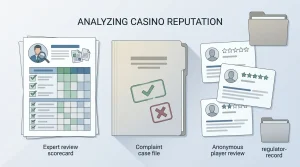


A practical look at licensing, operator records and the safeguards that matter when assessing a casino serving Great Britain.
What a UK Casino Licence Actually Covers
For an online casino offering real-money gambling to people in England, Scotland or Wales, the central test is whether the operator holds a UK Gambling Commission licence for that activity. The rule follows the market being served, not the address on a company’s paperwork. A business based outside Great Britain does not avoid the requirement by operating from abroad or presenting itself as an international brand.
The Gambling Commission’s remit includes remote gambling made available to consumers in Great Britain. In practical terms, a casino does not become exempt from that framework because customers use a website rather than visit a physical premises, or because the business is incorporated elsewhere. If an operator offers facilities for remote gambling to people in Great Britain, it needs the relevant Commission licence.
That distinction matters when assessing whether a site is a trusted online casino in the UK. A polished website, familiar games or a UK-facing domain can describe how a business presents itself; none of those features answers the licensing question. The relevant point is whether the business offering the gambling is authorised by the regulator to serve this market. The licence is a threshold requirement, not an optional quality mark.
VPN-Friendly Casinos in the UK: Rules and Risks
The operator, not just the brand
Casino brands and operating companies are not always named in the same way. A brand may be the name visible to customers, while a separate company provides the gambling service. For that reason, a search for a brand name alone may not make the relationship clear. The key regulatory question is which operator is behind the service and whether that operator holds the appropriate UKGC Licence.
This is also why a company’s location should not be treated as a shortcut to a conclusion. A foreign address does not, by itself, prove that a casino is outside the British licensing requirement. Equally, a UK-facing appearance does not establish that the operator holds a licence. The test is tied to the provision of remote gambling to consumers in Great Britain, rather than to the operator’s country of establishment or the visual design of its site.
Non-UK casinos: regulation, licences and protections
A licence therefore answers a specific question: whether the operator has the regulatory authorisation required to offer the relevant gambling service in this market. It does not turn a brand into a “best” or “most trusted” choice, and it does not provide a comparative ranking of casinos. Those are broader judgements, while licensing is a legal status. Combining the two without evidence makes a regulatory record say more than it does.
What the licence test does—and does not—mean
The word “licensed” can be used loosely in casino marketing, so it is worth separating the claim from the evidence it requires. For a real-money online casino serving customers in England, Scotland or Wales, the meaningful claim is that the operating business holds the relevant UK Gambling Commission licence. A reference to a licence from another country does not replace that requirement for the British market.
The location rule is straightforward, even where the company structure is not. A remote operator may be headquartered abroad, use a separate brand, or have more than one company involved in its business. None of those facts changes the basic test: the business offering gambling to Great Britain consumers must have the required UK authorisation. Corporate geography is not a substitute for regulatory status.
A trusted UK online casino should therefore be understood first as a casino whose operator is properly authorised for the market it serves. That is a necessary starting point, not a complete assessment of the customer experience or a promise about every aspect of a business. The licence establishes the relevant permission to operate; it does not make every promotional claim, payment arrangement or account decision self-explanatory. Those matters need to be considered on their own terms.
The same principle applies to descriptions such as “regulated casino” or “UK casino”. A site may use British currency or address British customers, but presentation alone does not demonstrate authorisation. Conversely, an operator being based outside Great Britain does not settle the issue against it. The deciding factor is whether it offers remote gambling to consumers in Great Britain and, if so, whether it holds the licence required for that service.
A UK Gambling Commission licence is a legal threshold requirement for operators serving Great Britain, not an optional quality mark or a comparative ranking of casinos.
For anyone comparing trusted UK online casinos, this makes the licensing question narrower—and more useful—than a general claim of trust. It identifies the legal gate an operator must pass before offering real-money remote gambling in Great Britain. It does not certify that one casino is better than another. A licence is a condition for lawful market operation, not a medal.
Real-Money Play: Limits, Verification and Account Controls
A real-money account is not ready for deposits or play until the operator has completed identity and age checks. In the UK, verification must take place first; it is not a step that can be left until a withdrawal is requested. Operators must also establish a customer’s age before allowing funds to be deposited. That makes verification a condition of opening the account for use, rather than an optional administrative task.
The checks commonly involve a passport or driving licence and a recent utility bill. These documents help establish identity and address, but the operator may ask for information needed to resolve identity or payment-ownership questions. The precise request depends on the account and the operator’s checks. Until those checks are satisfied, a welcome offer or a payment method cannot make the account available for real-money play.
Slot stakes depend on age
Online slots have a maximum stake per spin. A specialist review reports a cap of £5 per spin for players aged 25 and over, and £2 for those aged 18 to 24. These are stake ceilings, not recommended amounts or minimums. The relevant figure is the amount staked on each spin; a sequence of smaller bets does not turn the cap into a session budget.
USA Casinos for UK Players: Regulation and Risks · Online Casinos with No Sister Sites in the UK
The age distinction matters when an account is set up and when play begins. A displayed game or account balance does not override the applicable stake limit. Nor does a bonus change the maximum permitted stake. Where a game’s controls allow a larger amount to be selected, the permitted ceiling still governs the stake.
These limits concern online slots, not every casino game. They should not be carried over to live tables or other products without a separate rule establishing that treatment. For a player comparing real-money slots, the practical check is therefore narrow: confirm the age category used for the account and keep each spin within its applicable cap.
Account limits are not all changed on the same timetable
Financial limits provide a separate control from the stake limit on an individual spin. Remote operators must prompt new customers to set a financial limit before their first deposit and make account-level limit controls accessible. The purpose is to let the customer set a boundary on account activity before money enters the account, rather than relying only on the game’s stake settings.
The timing of a change depends on its direction. A reduction takes effect immediately. An increase is subject to the standard cooling-off delay. The difference is material: lowering a limit can restrict activity at once, while raising it does not immediately restore access to the higher amount. An account should not be treated as having an increased limit until the delay has passed and the change has taken effect.
Do
- Reduce financial limits for immediate effect
- Observe the cooling-off delay when increasing limits
Don’t
- Expect an increase in limits to take effect instantly
- Treat a request to loosen restrictions as an immediate change
This distinction also affects how an advertised limit-control feature should be read. The existence of a control does not mean every adjustment is instant. A reduced limit can provide an immediate restriction; a request to loosen the restriction follows a different process. The arrangement is designed so that increasing access to funds is not as immediate as reducing it.
Keep the account controls distinct
Three checks are often conflated: identity and age verification, the maximum stake on a slot spin, and account-level financial limits. They do different jobs. Verification establishes whether the account may be used; the slot cap restricts the size of an individual spin; account limits set a broader boundary on activity. Passing one check does not remove the others.
A real-money account therefore has conditions before and after its first deposit. Before deposit or play, identity and age must be verified, and a financial limit must be set. During play, each slot spin remains subject to the applicable age-based cap. If an account limit is changed, a reduction applies immediately, while an increase waits through the cooling-off period. These operating conditions are more useful measures of how an account functions than the word “trusted” in a site description.
Reading a Casino Site’s Register Entry and Enforcement Record
A casino name on a website is not, by itself, enough to identify the company responsible for its operation. The public register provides a more useful link: it can show which licensed operator is associated with a domain and what kind of relationship is recorded. That distinction matters when assessing a casino’s credentials. A brand and its operator may have different names, so searching only for the brand can leave the relevant record undiscovered.
Non-UK Registered Casinos: Licensing and Player Risks
For 333casino.com, the Gambling Commission’s register identifies Grace Media (Gibraltar) Limited as the associated operator. The entry gives the operator account number as 57869 and describes the domain as a White Label domain. This is a record of the relationship between the named domain and the operator; it is not a general endorsement of the brand, nor a finding that every aspect of its service is satisfactory.
“White Label” is the key detail to read rather than skim. It indicates that the domain is recorded in connection with an operator under that arrangement. For a person checking a casino, the practical result is that the brand name alone may not be the name to look up in the operator register. The operator’s account number and legal name make the connection more precise, while the domain entry helps establish that the record relates to the site in question.
That connection should be read alongside enforcement information. On 26 June 2025, the Gambling Commission issued Grace Media a financial penalty of £60,000. The breaches concerned self-exclusion and consent for direct electronic marketing. The penalty therefore relates to specific compliance failures, not to an abstract judgement about whether a site is “trusted”. It is still material: self-exclusion controls and marketing permissions affect how gambling businesses interact with customers, and the regulator treated the failures as serious enough to impose a financial sanction.
The register entry and the enforcement record answer different questions. The first identifies the operator associated with a domain and gives a way to distinguish the business behind the brand. The second records regulatory action against that operator, including its date, amount and subject. Neither should be made to do the other’s job. A listed domain does not erase an enforcement outcome; a penalty does not change the identity of the operator shown in the register.
Checking Casino Credentials
Identify the Operator
Use the Gambling Commission’s public register to find the licensed operator and account number associated with the domain.
Verify the Relationship
Check if the domain is recorded as a White Label or under another specific arrangement.
Review Enforcement Records
Search for any dated regulatory actions, such as financial penalties, involving the identified operator.
This is a more disciplined basis for judging a casino than relying on a label such as “trusted”. Such labels often compress several separate checks into one reassuring word. The record instead gives testable details: domain, operator, account number, relationship type and any recorded enforcement action. Those details can be compared without turning the result into a ranking of trusted casino sites or treating one operator’s history as proof about every brand associated with it.
There is also a time element. Register details and regulatory records describe what is recorded at the point they are checked; they are not permanent guarantees about future ownership, arrangements or conduct. A careful assessment therefore keeps the date of a record in view and avoids carrying an old conclusion forward without checking whether the underlying entry has changed. The same principle applies to enforcement: a dated action should be described as a dated event, not as a claim that the operator’s current position is identical in every respect.
For 333casino.com, the available documentary picture is specific: the register links the domain to Grace Media (Gibraltar) Limited under account 57869 as a White Label domain, and the regulator’s record includes the 2025 penalty concerning self-exclusion and direct electronic marketing consent. That is enough to describe the relationship and the enforcement history accurately. It is not enough to turn the brand into a recommendation, or to use a favourable or unfavourable label in place of the records themselves.
What “Best” Can Mean When the Evidence Is an Operator Record
Choosing a trusted UK casino in 2026 calls for checking what is actually known rather than relying on broad claims. These entries provide a concise reference point: the stated payout speed for each operator.
1. EvoSpin
Payout speed: 1-3 business days EvoSpin’s stated payout speed is 1–3 business days. This is the available factual point for assessing the operator here.
2. SpinFormula
Payout speed: 1-3 business days SpinFormula’s stated payout speed is 1–3 business days. This is the available factual point for assessing the operator here.
3. Zombillion
Payout speed: 1-3 business days Zombillion’s stated payout speed is 1–3 business days. This is the available factual point for assessing the operator here.
4. BeOnBet
Payout speed: 1-3 business days BeOnBet’s stated payout speed is 1–3 business days. This is the available factual point for assessing the operator here.
5. Jetsetspins
Payout speed: 1-3 business days Jetsetspins’ stated payout speed is 1–3 business days. This is the available factual point for assessing the operator here.
6. Revery Play
Payout speed: 1-3 business days Revery Play’s stated payout speed is 1–3 business days. This is the available factual point for assessing the operator here.
7. NightWin
Payout speed: 1-3 business days NightWin’s stated payout speed is 1–3 business days. This is the available factual point for assessing the operator here.
8. Chanze
Payout speed: 1-3 business days Chanze’s stated payout speed is 1–3 business days. This is the available factual point for assessing the operator here.
9. SlotoSport
Payout speed: 1-3 business days SlotoSport’s stated payout speed is 1–3 business days. This is the available factual point for assessing the operator here.
10. Amunbet
Payout speed: 1-3 business days Amunbet’s stated payout speed is 1–3 business days. This is the available factual point for assessing the operator here.
A “best” label is a judgement, not a record of who is legally responsible for a casino. It may describe an editorial preference, but it cannot establish the identity of the licensed operator or the relationship between that operator and a website. Those details are more useful for checking the basis of a trust claim than a ranking alone.
The Gambling Commission’s public register separates operator details from domain details. Its operator entry lists LeoVegas Gaming PLC under account number 39198. The domain register identifies leovegas.co.uk as the active UK-facing domain associated with that same account number. Read together, the entries connect a named website with a named operator through a matching identifier.
That distinction matters because a domain and a licensed company are not interchangeable. The domain is the web address presented to customers; the operator entry identifies the company recorded by the regulator. In this case, the register provides a way to trace the UK-facing LeoVegas domain to LeoVegas Gaming PLC, rather than treating the brand name as sufficient evidence on its own.
The record supports a specific conclusion: the Commission associates leovegas.co.uk with operator account 39198, and lists LeoVegas Gaming PLC under that account. It does not establish that LeoVegas is the best casino, that its games are superior, or that every player will consider it trustworthy. A register is not a review score, and an account match is not an endorsement. Keeping those categories separate avoids turning a verifiable detail into a broader claim it cannot carry.
LeoVegas Register Example
The Gambling Commission’s operator entry lists LeoVegas Gaming PLC under account number 39198, while the domain register identifies leovegas.co.uk as the active UK-facing domain associated with that same account number.
The same distinction applies when a casino is described as one of the most trusted in the UK. A useful claim should be capable of being checked against the operator and domain records, rather than relying on the word “trusted” as proof. A ranking can indicate an opinion; it cannot replace the link between the site a customer sees and the company recorded as its operator.
For games, the relevant question is different again. A trusted operator record does not certify the quality or outcome of individual casino games. The register evidence concerns the website and its operator, not a guarantee about particular titles or results. Treating those as separate checks keeps the meaning of the evidence precise.
LeoVegas provides a concrete example of how the two register entries fit together: one names the operator, while the other records the UK-facing domain under the same account number. That is a stronger basis for identifying responsibility than a “best” label by itself, but it remains a narrow finding. It says who is connected to the domain in the register, not which casino deserves a universal ranking.
Crypto Casinos: The Licence Test Still Applies
A crypto payment label does not answer the regulatory question. The relevant point is whether a gambling business offers facilities to people in Great Britain. If it does, it needs the applicable UK Gambling Commission licence, even when the company is based elsewhere. The payment method does not replace or remove that requirement.
This separates two issues that are often blurred together. One is how a casino may handle payments; the other is whether the business is authorised to offer gambling to consumers in Great Britain. A reference to cryptocurrency, or to a particular coin, settles neither the operator’s location nor its licensing position. Trust cannot be inferred from the payment label.
Anjouan Casino Licence in the UK: What It Means
That distinction matters when assessing claims about a trusted crypto casino in the UK. A site’s description of itself is not evidence that it holds the required UKGC Licence. Nor does a foreign corporate address create an exemption for a business serving the British market. The licensing test concerns the service offered to consumers in Great Britain, not the branding used for its payment options.
The same reasoning applies to claims about “top” or “most trusted” crypto casinos. Those phrases are evaluations, not regulatory categories. Without evidence connecting a gambling service to the required licence, a positive label cannot establish that it is authorised to operate in Great Britain. Conversely, a crypto-related payment description alone does not establish that a particular site accepts a coin or provides any specific payment arrangement.
A careful assessment therefore keeps the claims separate: what the site says about payments, where the gambling is offered, and whether the relevant operator holds the required licence. Each is a distinct question. A payment option cannot stand in for the licence, and a licence claim cannot by itself confirm which payment methods are available.
The rule is based on the market served rather than the company’s home base. A business located outside Great Britain still falls within the licensing requirement when it offers gambling facilities to consumers there. That makes the payment label a poor shortcut for judging whether a casino is regulated: the decisive issue remains the gambling service and its relationship to the British market.
Casinos & Safety: UK Licensing and Player Checks
No particular Bitcoin- or Dogecoin-accepting casino can be identified on that basis. The regulatory principle can be stated without making claims about products: crypto-related payments do not create a separate route around the UKGC Licence requirement for remote gambling offered to consumers in Great Britain. A site’s payment wording and its authorisation are separate matters, and one does not prove the other.
Great Britain and Northern Ireland Are Not the Same Licensing Territory
“UK casino” can sound like a single regulatory category. For remote gambling, that shorthand obscures a territorial distinction: the Gambling Commission’s remit under the Gambling Act 2005 covers Great Britain, while Northern Ireland is not part of its remote-gambling jurisdiction.
Great Britain means England, Scotland and Wales. The Commission regulates remote gambling offered to consumers there. Northern Ireland has a separate legal position, so the Great Britain licensing framework should not be treated as if it automatically governs remote gambling there in the same way.
That distinction matters when assessing a claim that a casino is trusted across the UK. A UKGC Licence is relevant to the operator’s authority to serve customers in Great Britain. It does not, by itself, resolve the separate question of the rules governing remote gambling in Northern Ireland. The territory in which the customer is located is therefore part of the licensing question, not a minor detail in a site’s branding.
The reverse inference is also unsafe: an operator’s status under Northern Ireland’s arrangements cannot be inferred from its position in the Gambling Commission’s register. The two jurisdictions should be considered separately rather than collapsed into one label. A broad description such as “UK-licensed” can conceal which regulator and territory are actually being discussed.
Non-UKGC Licensed Casinos: What Overseas Status Means
This is a qualification to the meaning of trusted UK casinos, not a claim that one territory’s framework is stricter or more dependable than the other. It sets a boundary around what a Great Britain regulatory record establishes. Where the question concerns a customer in England, Scotland or Wales, the Gambling Commission’s remit is the relevant one. Where it concerns Northern Ireland, that remit does not extend to remote-gambling provision in the same way.
The practical reading is precise: identify the territory first, then assess the applicable regulatory framework. A UK-wide label is not a substitute for that distinction. A record that establishes a connection to Great Britain’s regulator should not be presented as proof of regulatory status in Northern Ireland, and Northern Ireland’s separate position should not be used to blur the rules that apply in Great Britain.
Bonuses and Free Spins: Calculate the Turnover Before the Offer
A bonus amount is not the same as withdrawable cash. Where an offer carries a wagering requirement, the key figure is the total stake that must be placed before the terms allow a withdrawal. For instance, a specialist review describes a £20 bonus with 10x wagering: the calculation is £20 multiplied by 10, giving £200 in required stakes. That is turnover, not a £200 payment to the account and not a promise that the balance will remain intact while the stakes are made.
The calculation depends on what the multiplier applies to. Terms may define wagering against the bonus, the deposit, or both, so the headline amount alone does not establish the full requirement. If the wording is unclear about the calculation base, the final stake total cannot be determined reliably. A large multiplier on a small bonus and a smaller multiplier on a larger qualifying amount can produce materially different obligations.
Bonus Turnover Calculation
Determine the Bonus Amount
Identify the bonus value, for example, £20.
Apply the Wagering Multiplier
Multiply the bonus by the wagering requirement (e.g., 10x).
Calculate Total Stakes
£20 multiplied by 10 equals £200 in required stakes before withdrawal is permitted.
Game contribution changes the practical amount of play needed. A specialist review describes slots as contributing the full stake towards wagering, while live tables and blackjack may count at a lower rate or not count at all. Where a game contributes only part of each stake, the player must place more total wagers to meet the same nominal requirement. The offer terms, rather than the game label, determine the accounting.
Eligibility is another cost condition. Specialist reviews describe welcome deals as commonly restricted to new customers, limited to one per household, and sometimes unavailable with particular payment methods, including e-wallets. A deposit made with an excluded method may therefore fail to qualify even when the advertised bonus is otherwise attractive. The qualifying deposit method and any household restriction should be checked before the offer is activated.
Bonus funds and free spins also have expiry conditions. A specialist review describes expiry periods commonly ranging from 7 to 30 days, but the offer’s own terms set the operative deadline. An unused bonus or unplayed spin can lose its value when that period ends; accumulated bonus winnings may also remain subject to wagering terms. The deadline matters because it limits the time available to complete the required turnover.
Promotion controls are relevant to how offers arrive, not just to their arithmetic. Casinos must give customers more control over the types of promotions they receive and the channels used to send them. That makes the distinction between an offer’s marketing and its conditions important: the promotion can be declined or channel-controlled, while accepting it binds the account to its stated eligibility, turnover and expiry rules. A free-spin count or bonus headline is only the starting value; the payable outcome depends on the conditions attached.
Casino Without a Swedish Licence: UK Regulation
Casino Apps: Check the Same Safeguards as the Website
A casino app is another way to access a remote gambling service; it does not create a separate regulatory category. For customers in Great Britain, the relevant question remains whether the operator offering the gambling holds the required UKGC Licence. The app’s presence on a phone does not itself establish that status.
This distinction matters when assessing claims about trusted casino apps in the UK. A polished interface, an app-store listing or a familiar brand name describes the access route, not the operator’s regulatory position. The licence belongs to the gambling business, so the app and the website should be understood as routes to that service rather than independent evidence of compliance.
The Gambling Commission regulates remote gambling offered to consumers in Great Britain. Operators within its regime must participate in GAMSTOP, the national online self-exclusion scheme. That participation became compulsory on 31 March 2020. It is an operator obligation, not an optional app feature that can be added or removed according to a user’s device.
The practical check is therefore tied to the operator behind the app. Its UKGC Licence status and its relationship to the app should be clear; the app alone cannot answer either point. A site and its app may share an operator, but the appearance of one does not prove that the other is licensed.
Participation in GAMSTOP, the national online self-exclusion scheme, became compulsory for all operators within the Great Britain regime on 31 March 2020.
GAMSTOP participation is part of the safeguards required of operators in the Great Britain regime. It should not be confused with a guarantee about every other aspect of an app or service. App access changes the interface; it does not replace the underlying licensing framework or transfer responsibility away from the operator.
Bitcoin and Dogecoin Payments: What the Verified Facts Do Not Establish
A casino described as accepting Bitcoin or Dogecoin makes two separate claims: that it offers gambling and that it supports a particular payment arrangement. The currency label alone establishes neither the identity of the gambling operator nor its regulatory status. It is not a substitute for an operator name, a UKGC Licence or a clear account of how deposits and withdrawals are handled.
For consumers in Great Britain, the relevant licensing question is whether a remote gambling business offers facilities to them. If it does, it needs the relevant UK Gambling Commission licence, regardless of where the business is based. A payment method does not change that test. Nor does a crypto label, by itself, show that a site is licensed, that a particular coin can be used, or that withdrawals are available in that coin.
That distinction matters when assessing claims about trusted Bitcoin or Dogecoin casinos serving the UK. “Trusted” is not a payment feature and cannot be inferred from a coin’s name appearing in promotional material. The operator behind the gambling service remains the key entity: a brand, domain or wallet-related claim should not be treated as proof of the operator’s licence.
Deposit and withdrawal availability are separate. A statement about one does not establish the other, and neither confirms the operator’s regulatory position. Before any deposit, the operator’s identity and current UKGC Licence status need to be checked against the UK Gambling Commission’s public register. If the business offering gambling to Great Britain consumers does not hold the relevant licence, a cryptocurrency payment option does not supply one.
Casinos Not on GamStop in the UK: Rules and Risks
The practical conclusion is narrow. Bitcoin and Dogecoin are payment labels, not evidence of licensing or trustworthiness. A UK-facing casino claim has to stand on the operator and its regulatory status, rather than on the novelty of the payment method.
Live Tables, E-Wallets and Withdrawal Timing
Live-table play does not determine how quickly a withdrawal reaches an account. The payment route and any outstanding account checks are separate parts of the process, so a displayed processing estimate is not necessarily the time until funds are available.
A specialist review reports that a first withdrawal may take an additional 12–24 hours while documents are checked. That is an added review period, not a guaranteed timetable for every account. Where identity or payment-ownership questions remain, the operator’s review can delay release before the payment provider’s own processing begins.
The same review gives PayPal withdrawal estimates of 4–6 hours on weekdays, extending to 8–10 hours from Friday to Sunday. These are reported processing times, not a promise that every request will clear within those windows. Debit card withdrawals are reported as taking 2–3 banking days after the operator has completed its review. The two routes therefore have different stated timelines, and neither removes the possibility of an initial check.
Merkur Casino Online in the UK: Games and Access
E-wallets can also affect the value of a welcome deal. A specialist review notes that some offers exclude payment methods such as e-wallets, even where the method can be used for transactions. Eligibility should be treated as a separate condition from whether deposits or withdrawals are available through that route. A payment option does not, by itself, establish bonus eligibility.
The practical comparison is therefore between the offer terms and the withdrawal route: check whether an e-wallet is excluded, whether a first withdrawal triggers document checks, and whether the quoted timing refers to operator review or the onward transfer. Live tables do not change those payment conditions. A fast estimate attached to one method is not evidence that another method will clear at the same speed.
Is 333 Casino licensed for Great Britain?
The UK Gambling Commission register links 333casino.com to Grace Media (Gibraltar) Limited, operator account 57869, as a White Label domain.
What is the context of GAMSTOP and self-exclusion?
UKGC-regulated online gambling operators in Great Britain must participate in GAMSTOP, a self-exclusion scheme, and participation has been compulsory since 31 March 2020. Grace Media was fined £60,000 in June 2025 for breaches involving self-exclusion and direct electronic marketing consent.
How can I check whether a casino is legal?
Check the Gambling Commission’s public register for the operator behind the casino and confirm it holds the relevant UKGC licence for the gambling service. A brand name or UK-facing website alone does not establish that the operator is authorised.
Which casino payment methods are generally quickest?
PayPal withdrawals are listed as taking roughly 4–6 hours on weekdays and 8–10 hours from Friday to Sunday, while debit card withdrawals typically take 2–3 banking days after the operator’s review. First-time withdrawals may also need an extra 12–24 hours for document checks.
Material created by the team Jettbet