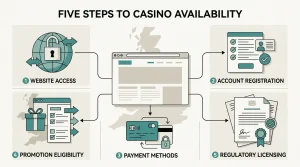


GamStop applies to UKGC-licensed operators, while sites outside that framework may have different checks, payment processes and safeguards.
What GamStop Covers—and Where Its Boundary Lies
GamStop is a self-exclusion service tied to the UK Gambling Commission’s regulatory framework. Its coverage is defined by the operator’s licence: registered users are restricted from gambling with establishments licensed by the UK Gambling Commission (UKGC). UKGC-licensed operators are required to participate, so GamStop is not an optional feature that an individual licensed casino can decide to omit.
That distinction matters because the service does not operate as a general block on every gambling website, casino brand or slot available online. Its reach follows the UKGC’s jurisdiction. A casino’s name, website design or catalogue of games does not determine whether GamStop applies; the relevant point is whether the establishment falls within the UKGC-licensed group.
The same principle applies to searches for a casino or slot site that is “not registered with GamStop”. The phrase can suggest that a casino has chosen not to sign up to a voluntary scheme. That is not an accurate description of the UKGC-licensed market: participation is required for operators holding the relevant licence. The boundary is regulatory, not a matter of a licensed operator’s preference.
Choosing a casino site outside GamStop can involve different considerations, so check the details that matter to you before signing up. This list provides a concise reference to the available payout-speed information.
1. EvoSpin
Payout speed: 1-3 business days EvoSpin lists a payout speed of 1–3 business days.
2. SpinFormula
Payout speed: 1-3 business days SpinFormula lists a payout speed of 1–3 business days.
3. Zombillion
Payout speed: 1-3 business days Zombillion lists a payout speed of 1–3 business days.
4. BeOnBet
Payout speed: 1-3 business days BeOnBet lists a payout speed of 1–3 business days.
5. Jetsetspins
Payout speed: 1-3 business days Jetsetspins lists a payout speed of 1–3 business days.
6. Revery Play
Payout speed: 1-3 business days Revery Play lists a payout speed of 1–3 business days.
7. NightWin
Payout speed: 1-3 business days NightWin lists a payout speed of 1–3 business days.
8. Chanze
Payout speed: 1-3 business days Chanze lists a payout speed of 1–3 business days.
9. SlotoSport
Payout speed: 1-3 business days SlotoSport lists a payout speed of 1–3 business days.
10. Amunbet
Payout speed: 1-3 business days Amunbet lists a payout speed of 1–3 business days.
GamStop’s restriction concerns access to gambling at participating establishments. It does not classify individual games as registered or unregistered. A slot does not have its own separate GamStop status: the relevant coverage comes from the establishment offering it. This is why labels such as “slots not on GamStop” can obscure the underlying arrangement. The service applies to the gambling establishment, rather than attaching an independent exclusion label to each game in its catalogue.
The difference between a site and a game is more than wording. A casino may offer slots alongside other forms of gambling, but the service’s scope is still determined at the operator level. A person looking for a particular type of game cannot infer GamStop coverage from the game category alone. Nor does a casino’s use of familiar game titles establish anything about whether the operator participates in the UKGC system.
For registered users, the practical effect within that system is a restriction on gambling with UKGC-licensed operators. Since those operators must participate, the framework does not depend on each casino making a separate decision to honour the exclusion. GamStop therefore has a defined reach: it covers the establishments within the UKGC’s jurisdiction, rather than every site that can be found online.
This also explains why broad descriptions such as “UK casinos not registered with GamStop” need care. “UK casino” may be used casually to describe a site that accepts customers in the UK, but the service’s coverage is not determined by how a site markets itself or by the location of a player. For GamStop purposes, the decisive boundary is the UKGC licence and the jurisdiction attached to it. The wording of a brand or its website cannot substitute for that distinction.
The term “safe” is also separate from the question of GamStop coverage. A site being outside the service’s coverage does not establish that it is safe, while participation in GamStop describes the operator’s place in the exclusion framework rather than every aspect of its conduct. The service’s scope is a specific regulatory fact, not a general quality rating.
Casinos & Safety: UK Licensing and Player Checks
In short, GamStop covers registered users in relation to establishments licensed by the UKGC, and licensed operators are required to take part. It should be understood as a defined self-exclusion arrangement within that regulatory system, not as a universal filter for all casinos, websites or slots. The label “not registered with GamStop” indicates a boundary question; by itself, it does not explain the operator’s licensing position or provide a broader assessment of the site.
Non-GamStop Sites and the UK Licensing Distinction
A casino’s licence and a player’s legal position are separate questions. A UK resident may use an online casino licensed outside Great Britain, and playing at a site not connected to GamStop is not, by itself, a criminal offence for that player. That does not mean the operator is authorised to provide gambling services to people in the UK. Under the British licensing framework, an operator offering real-money online gambling to UK customers must hold the relevant licence from the UK Gambling Commission (UKGC).
Legal Risk
An operator offering real-money online gambling to UK customers without a UKGC licence is acting unlawfully, regardless of any foreign licences they may hold.
The distinction matters because a licence issued elsewhere does not substitute for a UKGC licence. It may establish that an operator is regulated in the jurisdiction that issued it, but it does not give the operator permission to serve the British market. If an overseas casino accepts UK customers without the required UKGC licence, the legal exposure sits with the operator’s activity, not with the mere fact that a UK resident has placed a bet.
This is the point often blurred by descriptions such as “overseas-licensed” or “international”. Those labels describe location or licensing, not the scope of authorisation. A site can hold a foreign licence and still lack permission to offer gambling to people in Great Britain. Conversely, the fact that a site is accessible from the UK does not establish that its business is lawful there. Access is a technical condition; a licence is a regulatory one.
For a UK-facing casino, the relevant test is not whether the operator displays a licence badge, but whether it holds a current UKGC operating licence for the activity it offers. A foreign regulator’s approval cannot be treated as an equivalent UK authorisation. Nor does an operator become UK-licensed by accepting UK currency, presenting British-facing pages or taking registrations from UK residents. Those details do not change the licensing requirement.
The consequences also differ by party. A player using a casino without a UKGC licence is not committing a criminal offence simply by gambling there. The operator, however, cannot lawfully offer remote gambling to UK residents without the required UKGC permission. Saying that players may use overseas-licensed sites therefore describes the player-side position; it is not a declaration that the operator has a lawful right to serve the UK market. The two statements can both be true without cancelling each other out.
Casino Without a Swedish Licence: UK Regulation
That difference has practical weight. A UKGC licence brings the operator within the British regulatory system and the consumer protections attached to it. A casino outside that system does not provide those protections on the same basis. If a dispute arises, a foreign licence does not place the operator under UKGC oversight or give the player the same route through the British regulatory framework. The existence of a licence somewhere is not a transferable consumer safeguard.
The phrase “non-GamStop” can further confuse the issue because it describes whether a casino participates in the UK self-exclusion scheme, not whether it is authorised to operate in Britain. A site can be outside GamStop because it operates beyond the UKGC framework; that status should not be read as an alternative form of UK licensing. The licence question and the self-exclusion question are related through regulation, but they are not interchangeable.
Nor does a recent launch change the legal test. A newly opened casino is not entitled to serve UK residents merely because it is new, has a foreign authorisation or appears in discussions of casinos not on GamStop. Its UK status still turns on whether the operator holds the required UKGC licence. Popularity, availability and regulatory permission are separate entries in the ledger.
The clean distinction is therefore this: a UK player is not criminally liable merely for using a casino outside GamStop, while an operator offering gambling services to UK residents without a UKGC licence is acting unlawfully. A foreign licence may describe oversight in another jurisdiction, but it does not convert an unlicensed UK-facing operation into a licensed one.
Licensing vs Exclusion
A site may be outside GamStop because it operates beyond the UKGC framework; this status is not an alternative form of UK licensing.
Payments, Verification and the Cost of a Withdrawal Delay
A withdrawal has two separate clocks: the casino’s time to review and release it, and the payment provider’s time to deliver it. A short estimate for one stage does not establish when the full amount will arrive. The distinction matters at casinos not registered with GamStop, where payment procedures and verification requirements depend on the individual operator rather than the UKGC framework.
A specialist gambling review describes e-wallet withdrawals as generally faster than card withdrawals, while noting that casino processing can take up to 24 hours. That is a reported processing window, not a guaranteed arrival time. A payment may still be subject to the provider’s own handling after the casino releases it. Card withdrawals may therefore involve more waiting than an e-wallet transfer, but the precise sequence and timing depend on the operator and payment service. A headline payout estimate without those stages separated is incomplete.
Cryptocurrency can offer a fast transfer, according to a specialist gambling review, but speed is only one part of the calculation. The value of winnings can move with the cryptocurrency price between conversion and sale. A withdrawal expressed in a digital currency is not a fixed sterling amount: its sterling value can rise or fall while the transfer is under way or before it is exchanged. Any assessment of the result needs to account for both the amount sent and the value ultimately received.
Crypto transfers are irreversible. If a wallet address is entered incorrectly, the funds may be lost permanently; there is no card-style dispute process that can simply reverse a completed blockchain transfer. The address and network details are therefore part of the payment instruction, not administrative decoration. A fast transfer does not make an incorrect destination recoverable.
Online Casino No Registration UK: What It Means
Mobile billing presents a different limitation: a method used to put money into an account should not be assumed to provide a route for withdrawing winnings. The available withdrawal methods need to be checked separately from deposit options. A payment logo on a deposit page establishes neither that the same method supports withdrawals nor that it has a stated processing time. Where the withdrawal route is unclear, the amount and the route out remain uncertain.
KYC checks—identity verification required by the operator—can become a cost in time if they are left until a withdrawal is requested. A specialist gambling review recommends completing verification early to reduce the risk of a payout delay. This does not guarantee immediate release: it means that an unresolved identity check is less likely to be the outstanding step when funds are requested. Verification requirements should be read before depositing, including what must be supplied and when the operator may ask for it.
The useful comparison is therefore not simply “fast” against “slow”. It is the full route from request to receipt, the possibility of a review pause, and the currency in which the final value is held. E-wallets may be quicker than cards; crypto may transfer quickly while exposing value to price changes; and early KYC can remove one avoidable source of delay. None of those points makes a casino outside the UKGC system equivalent to a UKGC-licensed operator. Such sites may lack mandatory consumer protections, and access to UK-based gambling support services may not be available.
Do
- Complete KYC verification early to reduce payout delays
- Check separate withdrawal methods from deposit options
- Account for cryptocurrency price volatility during transfers
Don’t
- Assume a deposit logo guarantees a withdrawal route
- Rely on a single headline payout estimate
- Enter crypto wallet addresses without verifying network details
How to Read a Non-GamStop Casino Listing
A list of casinos not on GamStop is a starting point for checking claims, not evidence that any entry is licensed or suitable for use. The label describes a relationship with an exclusion service; it does not establish who regulates the operator, what protections apply, or whether the details on the page are current. A polished listing can still leave the most important question unanswered: which legal entity runs the casino, and under what authority?
GamStop is not a general register of online casinos. Casinos licensed outside the UK are not required by law to connect to the service. Their absence from GamStop therefore does not, by itself, confirm that a site is operating under a valid licence. Nor does a listing’s use of phrases such as “licensed casino” or “regulated platform” prove the claim. The wording is easy to publish; verification takes more work.
Check the regulator’s own record
A licensing statement should name the regulator and the company that holds the licence. Those details can then be checked against the regulator’s official database, rather than accepted from the casino’s footer, a listing, or a review. The regulator’s record is the relevant reference for whether a licence exists and whether it is current. If the listing names no authority, or the casino does not identify the licensed company, the claim cannot be checked properly.
Casino no ID verification in the UK: what it means
The names should match across the casino’s terms, its licensing statement and the regulator’s record. A licence belonging to a different company is not proof that the site in question is covered. A logo or licence number displayed on a page is also only a claim until it corresponds to an entry in the official register. If the record cannot be found or does not resolve the mismatch, the sensible conclusion is not that the listing has verified the casino; it has not.
For a UKGC licence claim, the UK Gambling Commission’s own register is the appropriate place to check. A listing that describes a site as licensed elsewhere should identify that regulator, so the stated authorisation can be checked in that authority’s official records. A search result, copied badge, or third-party summary is not a substitute for the regulator’s entry.
Separate the label from the legal position
“Not registered with GamStop” can describe why a casino does not take part in the service, but it is not a licence category. A site’s position depends on the operator and the market it serves, not on the wording used in a list. In Great Britain, remote gambling operators offering services to local customers must hold the relevant UK Gambling Commission licence. A foreign licence does not replace that requirement for an operator serving the British market.
This distinction matters because a listing may place several different claims beside one another: that a casino is outside GamStop, that it holds a foreign licence, and that it accepts UK customers. Each requires separate scrutiny. The first does not prove the second, and neither makes the third lawful for an operator that is offering gambling services to UK residents without the required UK licence.
Verify Casino Legitimacy
- Identify the legal entity running the casino
- Locate the named regulator and licence number
- Cross-reference details with the regulator’s official database
- Confirm the licence is current and matches the operator
A page describing an “online casino not registered with GamStop” should therefore be read as a description, not a regulatory endorsement. The same applies to a list of such casinos: inclusion is not confirmation of licensing, regulatory standing, or consumer protection. Where the operator’s identity or licence cannot be verified in an official record, the listing provides no reliable basis for treating the claim as established.
Which Sites Fall Outside GamStop—and What Self-Exclusion Means
Casinos not on GamStop are gambling sites that do not participate in the UK scheme. In practical terms, GamStop applies to casinos regulated by the UK Gambling Commission (UKGC); a site outside that regulatory system does not receive or apply GamStop exclusion information. This describes the boundary of the service, not a recommendation to use a site beyond it.
The distinction matters during an active exclusion. A person who has registered with GamStop is blocked from participating UKGC-licensed casinos for the period selected. A casino that does not cooperate with GamStop may not apply that restriction, but it also operates outside the UKGC framework. It therefore does not provide the same mandatory consumer protections, and responsible-gambling controls may not be required. Availability of voluntary controls cannot be assumed.
The term “not registered with GamStop” does not itself establish a casino’s licensing status or whether it can lawfully offer gambling to people in Britain. Casinos licensed outside the UK are not required to integrate with GamStop, but that does not make an operator’s offer to British residents lawful. Those are separate questions: whether the site participates in the exclusion scheme, and whether the operator holds the licence required to serve the British market. The label alone answers only the first.
A GamStop exclusion is set for a defined term: six months, one year or five years. The selected period cannot be shortened or cancelled early. That condition remains in force even if a site beyond the scheme does not recognise the registration. A lack of technical cooperation does not alter the exclusion or bring its end date forward.
This makes the period itself the relevant practical limit. Checking a casino’s licence is a separate assessment; it does not change the status of an active self-exclusion. Nor does a casino’s absence from GamStop establish that it is safe, equivalent to a UKGC-licensed operator or equipped with comparable safeguards. Non-UK sites operate outside UKGC oversight, and UK-based support services may not be accessible to people gambling with them.
The straightforward answer to which casinos fall outside GamStop is therefore a category, not a quality mark: casinos that are not UKGC-regulated and do not participate in the scheme. Their exclusion from GamStop says nothing by itself about the quality of their protections. For someone with an active registration, the selected restriction remains unchanged until its term ends.
Reputation Claims, PayPal Searches and the Limits of the Evidence
A casino described as reputable is being given a label, not a demonstrated level of protection. The word may appear in a review, a ranking or the operator’s own material; none of those labels, on its own, establishes that the site holds a UK Gambling Commission licence or provides the safeguards attached to one. The distinction matters because casinos not registered with GamStop operate outside the UKGC framework. They do not offer the same consumer protections as UKGC-licensed sites.
Non-GAMSTOP Curaçao Casino Sites: UK Rules Explained
Reputation is also not a fixed property. A favourable account of customer service or a payment experience does not establish how a later dispute will be handled, whether an account decision can be challenged effectively, or what recourse is available if a withdrawal is withheld. Those questions depend on the operator’s actual terms and the regulatory system that applies to it. A polished presentation is not a substitute for either.
A PayPal label needs the same separation between claim and evidence. A casino may be described as a PayPal casino in promotional material, but that wording does not by itself show that PayPal is available for deposits, withdrawals or both. Nor does the appearance of a payment logo establish that the method will be offered to every customer or remain available at the point of a transaction. Payment availability is a specific condition, not a general reputation score.
The relevant evidence would have to relate to the particular operator and the particular payment function being claimed. A broad statement that a site is trusted, popular or PayPal-friendly cannot settle those details. It can make the claim sound familiar; it cannot make the underlying conditions clearer.
There is a further distinction between a player’s position and the operator’s protections. Playing at a non-GamStop site is not a criminal offence for the player. That does not make the site equivalent to one operating within the UKGC system. If a dispute arises, the consumer protections associated with a UKGC licence are not available on the same basis. A reassuring reputation label cannot replace that framework.
For a financial decision, the useful question is not whether a site is called reputable, but what the claim actually establishes. A payment name alone does not establish access or the terms attached to it; a favourable review does not establish UKGC oversight. These are separate claims and require separate evidence. Without that separation, a single positive label can appear to cover licensing, payment access and dispute protection, though it proves none of them by itself.
Overseas Licensing: Jurisdictions Do Not Offer Identical Protection
A casino’s country of licensing identifies the regulator whose rules apply to its operation; it does not place the casino under every regulator whose residents can access its website. Non-UK casinos may hold licences in jurisdictions such as Malta, Gibraltar or Curacao. Those licences are distinct from a licence issued by the UK Gambling Commission (UKGC), and the authorities do not provide interchangeable oversight.
That distinction matters for casinos not registered with GamStop. The service’s exclusion data is not shared with non-UK casinos, which operate beyond the UKGC’s regulatory reach. A licence from another jurisdiction does not require an operator to check or enforce a GamStop registration. The operator’s licensing location, GamStop participation and permission to serve customers in Great Britain are separate questions.
A foreign licence should therefore be treated as a claim to verify, not as a general assurance of protection. The name of a jurisdiction on a casino page does not establish that the stated licence is current, belongs to the operator in question or covers the website being used. The relevant regulator’s official database is the appropriate place to check the operator’s identity and licence status. Details on the casino site should match the regulator’s records; a logo or licence number on its own proves little.
Attention: A foreign licence does not confer UKGC oversight or provide the same consumer protections attached to the British regulatory framework.
The regulator also matters because licensing standards and enforcement arrangements differ. A licence from outside the UK does not confer UKGC oversight or the consumer protections attached to that framework. In particular, less-established gambling authorities may not offer protection equivalent to UKGC regulation. The existence of a foreign licence cannot close that gap.
There is also a boundary between a casino being licensed abroad and its being authorised to operate in Britain. Remote operators offering gambling to customers in Great Britain must hold the relevant UKGC licence, regardless of where the business is based. A foreign licence does not replace that requirement. The fact that a site is reachable from Britain is not evidence that it is authorised to serve the British market.
For European casinos outside GamStop, the same distinction applies: a European location does not make an operator part of the UK system. The relevant questions are which authority issued the licence, whether its official records confirm the operator and site, and whether the operator holds the UKGC authorisation required to serve Great Britain. Geographic proximity is not a regulatory credential. A non-UK licence and no GamStop data-sharing can coexist, but neither should be mistaken for UKGC supervision.
Responsible-Gambling Controls Outside the UKGC Framework
A specialist review reports that some non-UK gambling sites provide tools such as deposit limits, loss limits, session time limits and reality checks. These controls are voluntary in this setting, not requirements imposed by the UK Gambling Commission. Their presence on one site therefore says nothing conclusive about what another site offers, or whether a control will work in the same way.
Some sites may also provide self-exclusion and reminders, even where their regulator does not require them. Availability is not guaranteed. A control may be absent, may cover only certain activities, or may operate under terms set by the operator. The practical value depends on what the feature actually restricts and how it is applied; a label alone does not establish its effect.
That differs from the UKGC framework, where licensed operators must participate in GamStop and meet regulatory requirements. Tools offered voluntarily by casinos not on GamStop do not become equivalent to UKGC protections simply because the names sound familiar. These casinos operate outside the UKGC system, so there is no basis for assuming that a limit, reminder or exclusion is backed by the same obligations or oversight.
Support is a separate concern. UK-based gambling support services may not be accessible to people using these sites, and the operator may not provide an equivalent service. That leaves a material gap if gambling becomes difficult to control: a feature on the account is not the same as access to independent help.
The terms should be read as operational conditions, not reassurance. A deposit limit concerns money added; a loss limit concerns losses; a time control concerns session duration. Reality checks are reminders, not necessarily restrictions. Self-exclusion is meaningful only to the extent that the operator applies it to the relevant account and gambling activity. Without a guaranteed common standard, the protection varies by site. When a control is missing or its effect is unclear, it cannot be treated as a dependable safeguard.
Responsible Gambling Outside UKGC
- Controls like deposit and loss limits are voluntary, not mandatory
- The effectiveness of safeguards varies by individual operator
- Access to UK-based gambling support services may not be available
- Voluntary tools are not equivalent to UKGC-backed obligations
Slots, Bonus Wagering and the Terms That Change the Final Amount
A bonus has a cash value only after its conditions are applied. The key calculation is the wagering requirement: the stated multiple is applied to the amount specified in the terms, which may be the bonus or a combined deposit-and-bonus figure. Those bases produce different turnover obligations, so the multiplier alone is not enough to compare offers.
Specialist casino reviews cite 30x to 40x as an industry-average range for wagering requirements; the same type of review describes requirements above 50x as generally predatory. These are review-based assessments, not a guarantee of what a particular offer contains. The relevant figure is the one in the casino’s own terms, together with the amount to which it applies.
Game weighting changes how quickly eligible play counts towards that requirement. Slots may count differently from table games, while table games can contribute less or nothing. A lower contribution means more qualifying stake may be needed to complete the same turnover target. A game’s appearance in a bonus promotion does not, by itself, establish that it contributes fully.
The remaining conditions can reduce the amount ultimately withdrawable. Bonus terms may set a maximum bet while wagering is in progress, a deadline for completing the requirement, and a cap on withdrawals from bonus winnings. A bet above the permitted maximum or a missed deadline can affect eligibility; a withdrawal cap can limit the final payout even when the wagering condition has been met. The headline bonus therefore cannot be treated as cash available on demand.
For online slots at casinos not on GamStop, the meaningful comparison is between the qualifying amount, the wagering multiple, game weighting, the permitted bet, the completion deadline and the withdrawal cap. If any one of these is unclear, the final amount cannot be calculated reliably. A large advertised bonus with restrictive conditions may produce less usable value than a smaller offer with transparent terms; the headline figure is packaging, while the conditions determine the result.
Why GamStop Workarounds Do Not Remove the Underlying Exclusion
An active GamStop exclusion remains in force for its selected period, even if a person finds a way to gamble elsewhere. Registering with an establishment that does not cooperate with GamStop may avoid the service’s block, but it does not cancel or shorten the original restriction. The distinction is practical: access may change; the exclusion status does not.
Reports have described attempts to register using another person’s personal details. That is not a reliable way to resolve an exclusion; it introduces a separate problem around whose identity and account are being used. A report by neconnected.co.uk has also described attempts involving anonymising tools, including VPNs, anonymous proxies and the TOR browser. These are accounts of possible workarounds, not evidence that they reliably provide access or remove the underlying restriction.
A land-based gambling venue is another setting outside an online block, but changing venue does not change the reason the exclusion was put in place. The same applies to casinos not on GamStop: their lack of cooperation may mean the service does not prevent registration there, but it does not restore eligibility with participating operators or end the self-exclusion period. Treating access elsewhere as a cancellation confuses a technical boundary with a change in status.
The clearest endpoint is the one built into the restriction: wait until the selected period has ended, then unsubscribe. Until then, an attempt to bypass the block is an attempt to gamble despite an exclusion, not a way to make that exclusion disappear. This matters because the restriction was selected to create separation from gambling; moving to another setting preserves access but removes that separation.
In financial terms, a workaround changes the route, not the underlying condition. It can also add uncertainty: another establishment may have different account rules and protections, and access is not evidence that the gambling is suitable or safe. The exclusion remains the relevant fact throughout. A route around it does not settle the original decision; the selected period ending does.
Can I reverse a self-exclusion from GamStop early?
No. A GamStop exclusion cannot be shortened or cancelled before the period you selected has ended.
What gambling sites are not on Gamstop?
Sites outside the UKGC’s jurisdiction, including some casinos licensed in Malta, Gibraltar or Curacao, may not participate in GamStop. A foreign licence does not authorise an operator to offer gambling to people in Great Britain without the required UKGC licence.
What is Gamstop?
GamStop is a self-exclusion service for UK residents that restricts registered users from gambling with UKGC-licensed operators. Those operators are required to participate.
How does Gamstop work?
You choose an exclusion period of six months, one year or five years, and participating UKGC-licensed establishments restrict your access to gambling for that period. The exclusion cannot be ended early.
How can I verify a casino’s licence is genuine?
Check whether the operator holds a current UKGC operating licence for the gambling activity it offers; a displayed badge or a foreign licence is not a substitute for UK authorisation to serve Great Britain.
How can players get around Gamstop?
GamStop does not cover establishments outside the UKGC’s jurisdiction, so they may not enforce a registration. If you self-excluded to control your gambling, seeking ways around that restriction can undermine your decision; consider sticking with the exclusion.
What’s the fastest way to get my winnings out?
E-wallet withdrawals are generally faster than card withdrawals, and casino processing can take up to 24 hours. Completing KYC verification early can help avoid delays; cryptocurrency withdrawals may be fast but their value can fluctuate.
Is it safe to play at non-Gamstop gambling sites?
Being outside GamStop does not establish that a site is safe, and sites without a UKGC licence do not provide the consumer protections associated with one. A foreign licence does not authorise an operator to offer gambling to people in Great Britain.
Material created by the team Jettbet